Showing posts with label Dumb?. Show all posts

Wednesday, June 9, 2010

Hooked on Gadgets, and Paying a Mental Price

NY Times Thinks the gadgets are dumbing em down... you are correct.
...the effects of the deluge of data. Even after he unplugs, he craves the stimulation he gets from his electronic gadgets. He forgets things like dinner plans, and he has trouble focusing on his family. His wife, Brenda, complains, "It seems like he can no longer be fully in the moment." 

This is your brain on computers. 

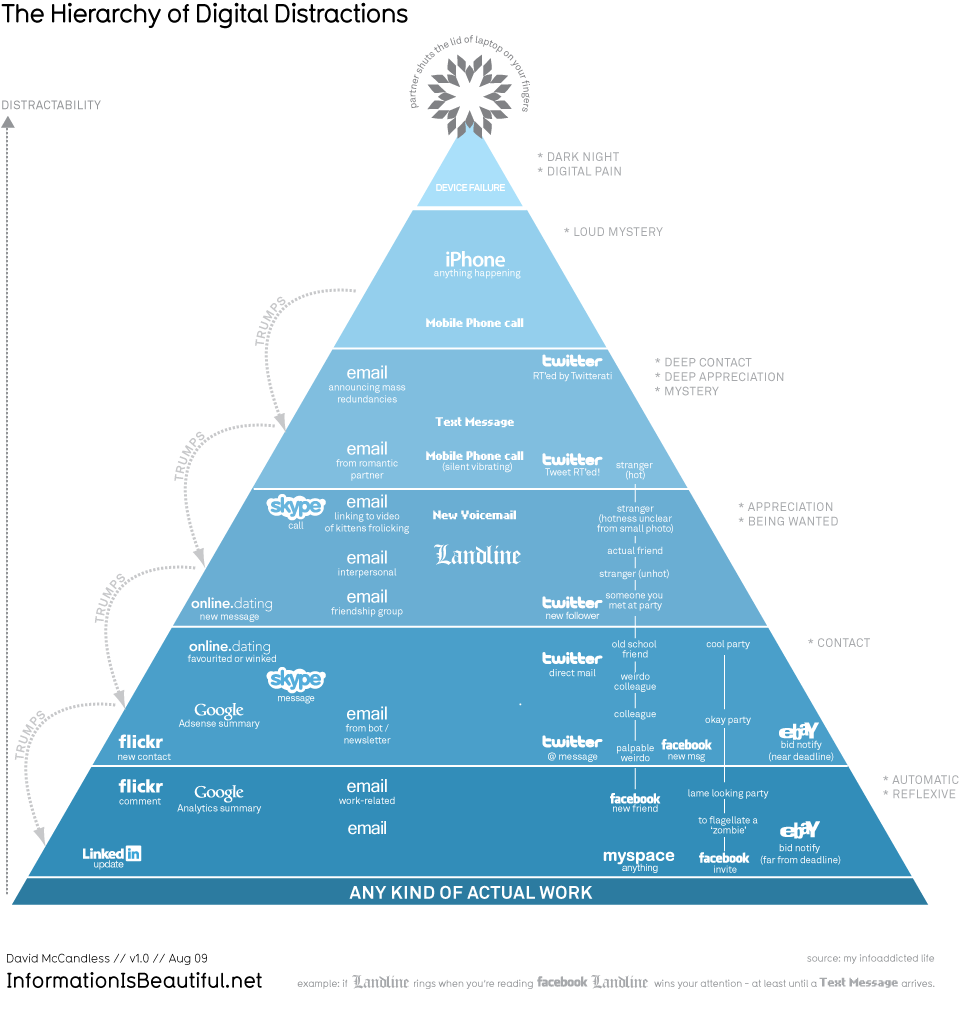
Researchers say there is an evolutionary rationale for the pressure this barrage puts on the brain. The lower-brain functions alert humans to danger, like a nearby lion, overriding goals like building a hut. In the modern world, the chime of incoming e-mail can override the goal of writing a business plan or playing catch with the children.
"Throughout evolutionary history, a big surprise would get everyone's brain thinking," said Clifford Nass, a communications professor at Stanford. "But we've got a large and growing group of people who think the slightest hint that something interesting might be going on is like catnip. They can't ignore it."

...researchers were unsure whether the muddied multitaskers were simply prone to distraction and would have had trouble focusing in any era. But she added that the idea that information overload causes distraction was supported by more and more research.

...multitaskers took longer than non-multitaskers to switch among tasks, like differentiating vowels from consonants and then odd from even numbers. The multitaskers were shown to be less efficient at juggling problems.

Other tests at Stanford, an important center for research in this fast-growing field, showed multitaskers tended to search for new information rather than accept a reward for putting older, more valuable information to work.

The results also illustrate an age-old conflict in the brain, one that technology may be intensifying. A portion of the brain acts as a control tower, helping a person focus and set priorities. More primitive parts of the brain, like those that process sight and sound, demand that it pay attention to new information, bombarding the control tower when they are stimulated.

Read on at NY Times

NOTE 2 SuperTechs:
research shows some people can more easily juggle multiple information streams. These "supertaskers" represent less than 3 percent of the population, according to scientists.

Friday, March 19, 2010

Young, Dumb, Full Of Risk For ID Theft

WashingtonPost - A new study finds that the young and the feckless are the most at risk for identity theft. 18-24 year olds are more likely to be victimized because they don't check their accounts frequently or thoroughly enough. You can beat the statistics, though, if 1 in 20 times you're tempted to check your friend's Facebook updates you instead scrutinize your account statements.  (Thanks to Ben Popken Consumerist!)

Wednesday, February 3, 2010

Dumbing down the world - digital nation on Frontline

Frontline: 'just want to push the pause button of our age and says, what's going on here?'
Quote: It's not that their dumb or not trying... they are trying in a way that is not as effective as it could be. - Because they are distracted by everything else.
The most brilliant minds wasted in an online waste land.

We have created a unlimited way to waste time, dilute the meaning of everything meaningful and distract ourselves from gaining any tangible knowledge or true happiness.
Your digital life is a virtual life, now you have to find out if you want an actual 'life'

The only way to 'live' may be to disconnect...

Monday, August 24, 2009

How To Go To MIT For Free

The businessinsider has written before about the foolishness of pursuing a graduate degree during an economic recession. This popular move--waiting out a recession in school--is actually dumb (see above). Under no circumstances should anyone spend an economic downturn piling on more debt for a degree. 

But there's one exception to the No Graduate School Rule. And that is the Sloan School of Management, the business school of MIT. Actually, it's pretty much all of MIT.

The reason why Sloan is an exception is because you can take nearly every course offered at Sloan without paying a dime, without quitting your job, without finding a new place to live in ultra-expensive Cambridge.

And that's because MIT now gives away its curriculum to anyone smart enough to learn it. It has posted its curriculum on-line for free. These days, this means a staggering 1900 courses. This number will grow.

You are probably skeptical about this. The so-called "Open-Course Ware" doesn't grant any degrees, and MIT says it doesn't count as an "MIT Education." You won't be able to hang a diploma on your wall. But here's what you will be able to do: learn almost everything an MIT student is being taught.


But why are you after that? Is it because you think it's valuable to employers? That might be the case on a temporary basis. But this over-valuation of a degree will eventually be arbitraged away. The smartest employers will quickly figure out how valuable it is to hire an applicant who can demonstrate he took all the MIT Sloan Business School courses online, by himself, and mastered them.  And ten years from now, no one will know or care whether you got the degree.

Are you a follower or a leader? How you go to business school--paying through the nose or going for free--tells you all you need to know.

Read more at Business Insider

Saturday, April 12, 2008

The Dumbing Down Of America

The Chronicle Of Higher Education has a commentary on the sorry state of ignorance that exists in American Universities, noting "Today's college students have tuned out the world, and it's partly our fault". One more example of what Hunter S Thompson called "The Dumbing Down Of America" - So Much for the Information Age. In recent years I have administered a dumbed-down quiz on current events and history early in each semester to get a sense of what my students know and don't know. Initially I worried that its simplicity would insult them, but my fears were unfounded. The results have been, well, horrifying.
Last fall only one in 21 students could name the U.S. secretary of defense. Given a list of four countries — China, Cuba, India, and Japan — not one of those same 21 students could identify India and Japan as democracies. Their grasp of history was little better. The question of when the Civil War was fought invited an array of responses — half a dozen were off by a decade or more. Some students thought that Islam was the principal religion of South America, that Roe v. Wade was about slavery, that 50 justices sit on the U.S. Supreme Court, that the atom bomb was dropped on Hiroshima in 1975. You get the picture, and it isn't pretty. Read more here by By Big Gav peakenergy

Sunday, April 6, 2008

Techno Crutches make you dumber than a POTHEAD

. . . A study carried out at the British Institute of Psychiatry . . found that excessive use of technology reduced workers' intelligence and that those distracted by incoming e-mail and phone calls saw a ten-point fall in their IQ, over twice the impact of smoking or marijuana use. . .

Programmers [for example ] know that task switches take a long time. It is easier to keep going once you're at full steam . . . than to stop work and finish later. That last hour might take three hours, since you have to retrieve all of the background info from long-term memory and bring it back to the front of your mind.

Studies report that the American worker wastes 2.1 hours per day due to multitasking. When distracted while performing a task, it takes a certain amount of time to begin the new task, complete the new task and get back on track with the original task. Microsoft employees had their computers log their work for a period and found that simply dealing with an e-mail message took an average of 15 minutes and often lead to subsequent distractions, which lead to the employee taking up to an hour to get back to their original task.

The bottom line is that multitasking has been proven to make us less effective, not more. Although our digital assistants can be time savers, they can also be time wasters, if we allow them to break our focus. So for all of you who trouble getting things done . . . turn off your chat, RSS feeds, Google Desktop, Outlook alerts and whatever else keeps distracting you, and see what it would it would be like to simply focus on [ the task at hand ].

Monday, February 18, 2008

The Dumbing of America

The zombie hordes are outside my window, ho hum, maybe I'll write a piece for the Washington Post.

Via: Washington Post:

"The mind of this country, taught to aim at low objects, eats upon itself." Ralph Waldo Emerson offered that observation in 1837, but his words echo with painful prescience in today's very different United States. Americans are in serious intellectual trouble — in danger of losing our hard-won cultural capital to a virulent mixture of anti-intellectualism, anti-rationalism and low expectations.

… source cryptogon

Monday, January 28, 2008

Multitasking Makes You Stupid, Slow and ADHD

 
"Multitasking messes with the brain in several ways. At the most basic level, the mental balancing acts that it requires — the constant switching and pivoting — energize regions of the brain that specialize in visual processing and physical coordination and simultaneously appear to shortchange some of the higher areas related to memory and learning. We concentrate on the act of concentration at the expense of whatever it is that we're supposed to be concentrating on... studies find that multitasking boosts the level of stress-related hormones such as cortisol and adrenaline and wears down our systems through biochemical friction, prematurely aging us. In the short term, the confusion, fatigue, and chaos merely hamper our ability to focus and analyze, but in the long term, they may cause it to atrophy."
 
Our freedom to stay busy at all hours, at the task—and then the many tasks, and ultimately the multitask—of trying to be free.
 

Tuesday, January 22, 2008

'dumbing down programs, hoping to make them more accessible and popular.

"A prior article on the damage Java does to CS education was discussed here recently. There was substantial feedback and the mailbox of one of the authors, Prof Dewar, also has been filled with mainly positive responses. In this follow-up to the article, Prof. Dewer clarifies his position on Java. In his view the core of the problem is universities 'dumbing down programs, hoping to make them more accessible and popular. Aspects of curriculum that are too demanding, or perceived as tedious, are downplayed in favor of simplified material that attracts a larger enrollment.'"  Read more of this story at Slashdot.

Monday, December 10, 2007

'don't put this in writing but ... ' Deleteing inappropriate e-mail can establish motive

Ever send an e-mail on your corporate account that you regret sending?
Ever think that deleting it from your local folder or from the server will save you from Legal's wrath?
 
Don't.
 
Several software packages that can detect several layers of deletion, which is worse than you might think. Let's say I send an e-mail to Char saying "You're dumb and no one likes you." Then I write another e-mail saying "You smell funny," but don't actually send it; it just stays on my computer in the draft folder. Then I delete it. Well, Johnny Law will see that I wrote it, then deleted it. They'll see my thought process, then throw my in prison for harassing Peter.
 
E-mails, text messages, BlackBerry communications all are potential time bombs if not worded thoughtfully and with discipline. "It just creates the potential for a permanent record for all this type of stuff," Clarke said. "People don't realize that to some degree, if it's in an e-mail, it's analogous to etching it in stone."
 
"My biggest fear with e-mails is not that it can be used against you in some way, but that the assumption is it's telling the whole story, and it's not," said Meece. "It may be the truth but not the whole truth, and there may be some silly stuff in there that's not 'nothing but the truth.'"
 
And above all, said Clarke, never say anything in an e-mail that you wouldn't want to see displayed on a giant screen in a court room in front of a judge and jury even years from now. Because that is exactly where it might end up.


Thursday, August 9, 2007

Social networks... more Harm or hurtful than helpful?

What is your take on social counter cultures?

The Cult of Us - What MySpace living is doing to our minds (from http://www.newscientisttech.com)

For millions of people, especially among the under-25s, online culture is becoming the only culture that matters. Take the plunge, and the world becomes one massive network in which users band together to share just about everything. Chatrooms and newsgroups have evolved into social networking websites such as MySpace and Facebook. Whatever your interest, from biology to extreme sports, there's a website where you can share your thoughts with the like-minded.

But what is the culture really about? Where will it end up? Too early to say, perhaps,

I'll have to ask my friends – Instant messaging, Wi-Fi and cellphones allow us to be constantly plugged into our social networks. Sociologist Sherry Turkle worries this is transforming human psychology

The end of privacy? – You wouldn't tell a stranger on the bus about your sexual habits, so why do people reveal this stuff on websites available to everyone? Will their openness return to haunt them?

I saw the best minds of my generation destroyed by Google – A short story by Bruce Sterling

The internet could be so much better – Social networking websites like MySpace or YouTube owe everything to the genius of Ted Nelson, who invented hypertext in the 1960s

Chris (WI)  comments:

Social update: While I think the web is a great place for media, data & connecting... it is by design a "anit-social" network. Only on the web will someone have a two hour talk on myspace to a "fictional" person... these social networks will be the erosion of our youth communication & social skills.   Furthermore the web has "dissolved" the need for general knowledge... if someone is not sure or doesn't know... they "google" it with no learning or cognitive thought involved. In the 90's most if the net was "solid" information... now social networks & (unqualified) mass media have fluffed and dumbdown the web to the point of less than 5% is new or relevant information.    I often get "cut n paste" ideas, answers, resume, replies and comments with no thought or creative conscience involved.   As you do in the "online game arena", I meet real people with real names on the science networks, that makes it still a good place to connect with people in a semi social way.    While I grew up on the internet & TV... but, was raised to turn them off and learn. Computers are tools created to enrich life not erode it.


Chris (ATL)  comments:

Personally, I think that social networks are helpful.  But, there should be limits.  I have joined several groups both for business and pleasure, and they are really only worth what you are willing to put into them.  Age is a factor that scares me about things like MySpace where kids of any age can interact with anyone.  I have a son... , so the internet makes me nervous.  Just knowing that he could possibly hop onto one of the sites while I have my back turned is scary.  One of my co-workers has 2 teenage daughters, and she got a program that records EVERYTHING that happens on her daughter's computers.  She can then see what is happening and talk to her kids.  I think that any parent out there that doesn't have such an animal is just asking for trouble.


Be the part of something bigger than ego's or economics.

"Tap The Glass" The real deal from industry leading scientists & professionals.


"Our lives begin to end the day we become silent about things that matter."   Martin Luther King Jr.


Yahoo! HackDay

Thursday, May 24, 2007

Why Your Top Performaning Employees Quit


Tuesday, May 15, 2007

Why Top Employees Quit

In a large company this is a problem that we have with our IT groups in particular. I reached out a to a few peers with other companies (one is an IT exec and one is actually a Group President) and as an exercise, we took a bunch of historical data and started identifying the factors that led to the annual exodus. We focused only the top 20% of the employees from a performance standpoint. It's not that the remaining 80% is unimportant, however, from a productivity, growth, and brainpower perspective, the top 20% of any group is critical. Moreover, these are the employees that are very difficult to replace.
To do this, we reviewed notes from exit interviews, cross referenced annual reviews and ultimately came up with 178 voluntary terminations from people that would have been considered in the top 20%.

To try and keep focused on macro issues, we consolidated the responses and placed them into categories:
  • Money
  • Unchallenged
  • Too Challenged
  • Dead Company
  • Watch your Levels (and the BS)


Here is the breakdown of the categories. I know someone is bound to ask why it doesn't add up so... Please keep in mind that this will not add up to 178 because several people insisted on listing 2-3 reasons when the question only asked for 1 reason.

Read on: http://www.dumblittleman.com/2006/09/why-top-employees-quit.html

Tuesday, March 27, 2007

Unfocused multitasking makes you less productive and dumb

Beyond IQ: Focus on the Task at Hand, "Attention span and reasoning" may get higher marks than intelligence...
© Jorge Delgado/iStockphoto

Inhibitory control is the ability to halt automatic impulses and focus on the problem at hand. For example, people use inhibitory control when they decide to take different routes to their jobs, because they have to make a conscious effort to override the regular route they otherwise would almost automatically follow.

Children with good inhibitory control are able, in essence, to multitask, or use known solution strategies in new ways. In this study 141 healthy children between the ages of three and five years took a battery of psychological tests that measured their IQs and executive functioning. Researchers found that a child IQ and executive functioning were both above average was three times more likely to succeed in math than a kid who simply had a high IQ.

"[The fact] that executive function, even in children this young, is significantly related to early math performance suggests that if we can improve executive function, we can improve their academic performance," says Adele Diamond, professor of developmental cognitive neuroscience at the University of British Columbia.
 
The key to successful "multitasking" and executive functioning at any age is to "tune" out multiple distractions and "self regulate" or focus on the task at hand. 
"When people divide their attention, they react more slowly and make more mistakes, scientists say."  New York Times beats the whole "multi-tasking reduces productivity" horse to death,  citing that studies show young people are not better equipped to handle interruptions having grown up with digital distractions.... jumping every time their phone buzzes or a new message appears in their inbox, straying off to reply to messages or browse news, sports or entertainment Web sites.  Based on surveys and interviews with professionals and office workers, concluded that 28 percent of their time was spent on what they deemed interruptions and recovery time before they returned to their main tasks... estimating the cost of interruptions to the American economy at nearly $650 billion a year.


Tuesday, March 20, 2007

Want a higher I.Q. Hint: Start Playing Grand Theft Auto...

Why I don't think like Char....

Rising trend line in intelligence test scores. And that, in turn, suggested that something in the environment - some social or cultural force - was driving the trend.


FROM WIRED - "The best example of brain-boosting media may be videogames. Mastering visual puzzles is the whole point of the exercise - whether it's the spatial geometry of Tetris, the engineering riddles of Myst, or the urban mapping of Grand Theft Auto."


Twenty-three years ago, an American philosophy professor named James Flynn discovered a remarkable trend: Average IQ scores in every industrialized country on the planet had been increasing steadily for decades. Despite concerns about the dumbing-down of society - the failing schools, the garbage on TV, the decline of reading - the overall population was getting smarter. And the climb has continued, with more recent studies showing that the rate of IQ increase is accelerating. Next to global warming and Moore's law, the so-called Flynn effect may be the most revealing line on the increasingly crowded chart of modern life - and it's an especially hopeful one. We still have plenty of problems to solve, but at least there's one consolation: Our brains are getting better at problem-solving.

But something else in the data caught his eye. Every decade or so, "Every time kids took the new and the old tests, they did better on the old ones," Flynn says. "I thought: That's weird."
Flynn dug up every study that had ever been done in the US where the same subjects took a new and an old version of an IQ test. "And lo and behold, when you examined that huge collection of data, it revealed a 14-point gain between 1932 and 1978."


The classic heritability research paradigm is the twin adoption study: Look at IQ scores for thousands of individuals with various forms of shared genes and environments, and hunt for correlations.


This is the sort of chart you get, with 100 being a perfect match and 0 pure randomness:
The same person tested twice: 87
Identical twins raised together: 86
Identical twins raised apart: 76
Fraternal twins raised together: 55
Biological siblings: 47
Parents and children living together: 40
Parents and children living apart: 31
Adopted children living together: 0
Unrelated people living apart: 0

What part of our allegedly dumbed-down environment is making us smarter?
It's not schools, since the tests that measure education-driven skills haven't shown the same steady gains. It's not nutrition - general improvement in diet leveled off in most industrialized countries shortly after World War II, just as the Flynn effect was accelerating.
"And then I realized that society has priorities. Let's say we're too cheap to hire good high school math teachers. So while we may want to improve arithmetical reasoning skills, we just don't. On the other hand, with smaller families, more leisure, and more energy to use leisure for cognitively demanding pursuits, we may improve - without realizing it - on-the-spot problem-solving, like you see with Ravens."


When you take the Ravens test, you're confronted with a series of visual grids, each containing a mix of shapes that seem vaguely related to one another. Each grid contains a missing shape; to answer the implicit question posed by the test, you need to pick the correct missing shape from a selection of eight possibilities. To "solve" these puzzles, in other words, you have to scrutinize a changing set of icons, looking for unusual patterns and correlations among them.


This is not the kind of thinking that happens when you read a book or have a conversation with someone or take a history exam. But it is precisely the kind of mental work you do when you, say, struggle to program a VCR or master the interface on your new cell phone.


Over the last 50 years, we've had to cope with an explosion of media, technologies, and interfaces, from the TV clicker to the World Wide Web. And every new form of visual media - interactive visual media in particular - poses an implicit challenge to our brains: We have to work through the logic of the new interface, follow clues, sense relationships. Perhaps unsurprisingly, these are the very skills that the Ravens tests measure - you survey a field of visual icons and look for unusual patterns.


The ultimate test of the "cognitively demanding leisure" hypothesis may come in the next few years, as the generation raised on hypertext and massively complex game worlds starts taking adult IQ tests. This is a generation of kids who, in many cases, learned to puzzle through the visual patterns of graphic interfaces before they learned to read. Their fundamental intellectual powers weren't shaped only by coping with words on a page. They acquired an intuitive understanding of shapes and environments, all of them laced with patterns that can be detected if you think hard enough. Their parents may have enhanced their fluid intelligence by playing Tetris or learning the visual grammar of TV advertising.

But that's child's play compared with Pokmon.

Intellectual breakthroughs are what happen when you're busy making other plans. (J.Lennon)

Wednesday, January 10, 2007

Infomania' worse than marijuana

Workers distracted by email and phone calls suffer a fall in IQ more than twice that found in marijuana smokers, new research has claimed.
Person using computer
The study for computing firm Hewlett Packard warned of a rise in "infomania", with people becoming addicted to email and text messages.

Researchers found 62% of people checked work messages at home or on holiday.

The firm said new technology can help productivity, but users must learn to switch computers and phones off.

Losing sleep
The study, carried out at the Institute of Psychiatry, found excessive use of technology reduced workers' intelligence.

Those distracted by incoming email and phone calls saw a 10-point fall in their IQ - more than twice that found in studies of the impact of smoking marijuana, said researchers.

More than half of the 1,100 respondents said they always responded to an email "immediately" or as soon as possible, with 21% admitting they would interrupt a meeting to do so.

The University of London psychologist who carried out the study, Dr Glenn Wilson, told the Daily Mail that unchecked infomania could reduce workers' mental sharpness.

Those who are constantly breaking away from tasks to react to email or text messages suffer similar effects on the mind as losing a night's sleep, he said.

Sunday, December 3, 2006

Your not dumb, your just running DOS

thinker.png
The brain is like a computer... so there really aren't any stupid people.
Just people running DOS.