"US security officials say the country's cyberdefenses are not up to the challenge. In part, it's due to a severe shortage of computer security specialists and engineers with the skills and knowledge necessary to do battle against would-be adversaries. The protection of US computer systems essentially requires an army of cyberwarriors, but the recruitment of that force is suffering. 'We don't have sufficiently bright people moving into this field to support those national security objectives as we move forward in time,' says James Gosler
Read more of this story at Slashdot.
Showing posts with label CyberCulture. Show all posts
Showing posts with label CyberCulture. Show all posts
Thursday, July 22, 2010
Thursday, July 8, 2010
Things 2dolist - Crack the "Cyber Command" logo
From da Boing2

As usual I have to agree with Bruce...
The U.S. Military's new "Cyber Command" logo contains a hidden code. Noah Shachtman at Wired News says, "Help us crack it!"
Related reading today: Bruce Schneier says "The Threat of Cyberwar Has Been Grossly Exaggerated."As usual I have to agree with Bruce...

Wednesday, June 16, 2010
Internet 'kill switch' proposed for US
CNET A new US Senate Bill would grant the President far-reaching emergency powers to seize control of, or even shut down, portions of the internet.
The legislation says that companies such as broadband providers, search engines or software firms that the US Government selects "shall immediately comply with any emergency measure or action developed" by the Department of Homeland Security. Anyone failing to comply would be fined.
 That emergency authority would allow the Federal Government to "preserve those networks and assets and our country and protect our people," Joe Lieberman, the primary sponsor of the measure and the chairman of the Homeland Security committee, told reporters on Thursday. Lieberman is an independent senator from Connecticut who meets with the Democrats.
Due to there being few limits on the US President's emergency power, which can be renewed indefinitely, the densely worded 197-page Bill (PDF) is likely to encounter stiff opposition.
TechAmerica, probably the largest US technology lobby group, said it was concerned about "unintended consequences that would result from the legislation's regulatory approach" and "the potential for absolute power". And the Center for Democracy and Technology publicly worried that the Lieberman Bill's emergency powers "include authority to shut down or limit internet traffic on private systems."
The NCCC also would be granted the power to monitor the "security status" of private sector websites, broadband providers and other internet components. Lieberman's legislation requires the NCCC to provide "situational awareness of the security status" of the portions of the internet that are inside the United States — and also those portions in other countries that, if disrupted, could cause significant harm.
Read full at CNET
The legislation says that companies such as broadband providers, search engines or software firms that the US Government selects "shall immediately comply with any emergency measure or action developed" by the Department of Homeland Security. Anyone failing to comply would be fined.

Due to there being few limits on the US President's emergency power, which can be renewed indefinitely, the densely worded 197-page Bill (PDF) is likely to encounter stiff opposition.
TechAmerica, probably the largest US technology lobby group, said it was concerned about "unintended consequences that would result from the legislation's regulatory approach" and "the potential for absolute power". And the Center for Democracy and Technology publicly worried that the Lieberman Bill's emergency powers "include authority to shut down or limit internet traffic on private systems."
The idea of an internet "kill switch" that the President could flip is not new. A draft Senate proposal that ZDNet Australia's sister site CNET obtained in August allowed the White House to "declare a cybersecurity emergency", and another from Sens. Jay Rockefeller (D-W.V.) and Olympia Snowe (R-Maine) would have explicitly given the government the power to "order the disconnection" of certain networks or websites.
A new cybersecurity bureaucracy
Lieberman's proposal would form a powerful and extensive new Homeland Security bureaucracy around the NCCC, including "no less" than two deputy directors, and liaison officers to the Defense Department, Justice Department, Commerce Department, and the Director of National Intelligence. (How much the NCCC director's duties would overlap with those of the existing assistant secretary for infrastructure protection is not clear.)The NCCC also would be granted the power to monitor the "security status" of private sector websites, broadband providers and other internet components. Lieberman's legislation requires the NCCC to provide "situational awareness of the security status" of the portions of the internet that are inside the United States — and also those portions in other countries that, if disrupted, could cause significant harm.
Read full at CNET
Sunday, May 23, 2010
Demise of net knowledge
THEN it was the ultimate tool of knowledge
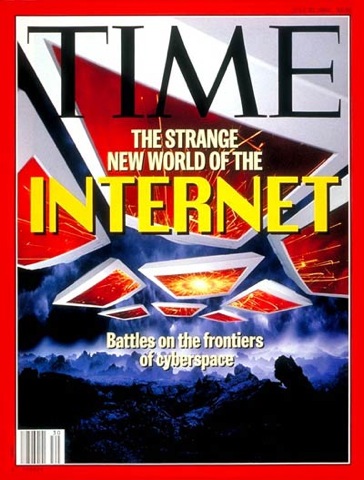
TIME: The Internet evolved from a computer system built 25 years ago by the Defense Department to enable academic and military researchers ... built up by people who lived and breathed the hacker ethic -- students at Berkeley and M.I.T., researchers at AT&T Bell Laboratories, computer designers at companies such as Apple and Sun Microsystems. "If there is a soul of the Internet, it is in that community," The scientists who were given free Internet access quickly discovered that the network was good for more than official business. They used it to send each other private messages (E-mail) and to post news and information on public electronic bulletin boards (known as Usenet newsgroups).
Now it is a tool for people to ...withdraw within their walled communities and never venture again into the Internet's public spaces. It's a process similar to the one that created the suburbs and replaced the great cities with shopping malls and urban sprawl. The magic of the Net is that it thrusts people together in a strange new world, one in which they get to rub virtual shoulders with characters they might otherwise never meet. The challenge for the citizens of cyberspace -- as the battles to control the Internet are joined and waged -- will be to carve out safe, pleasant places to work, play and raise their kids without losing touch with the freewheeling, untamable soul that attracted them to the Net in the first place.
Friday, February 23, 2007
Electroshock therapy for "Internet addicts"

The Chinese government is imprisoning and giving electric shocks to people it thinks have become addicted to the Internet.
Alarmed by a survey that found that nearly 14 percent of teens in China are vulnerable to becoming addicted to the Internet, the Chinese government has launched a nationwide campaign to stamp out what the Communist Youth League calls 'a grave social problem' that threatens the nation.
In terms of withdrawal: 'If you let someone go online and then he can't go online, you may see a physical reaction, just like someone coming off drugs.' And in terms of resistance: 'Today you go half an hour, and the next day you need 45 minutes. It's like starting with drinking one glass and then needing half a bottle to feel the same way.'"
Monday, January 29, 2007
65% of Americans Spend More Time With Their PC Than SO
Why is your marriage & family falling apart? "PR Newswire reports that 65 percent of consumers are spending more time with a computer than with their significant other (SO). The "Cyber Stress" study confirmed consumers' growing relationship with technology in their everyday lives. In fact, more than 8 out of 10 Americans (84%) say they are more dependent on their home computer now than they were just three years ago."
Tuesday, December 19, 2006
Harvard Spot on Digital Disobedience
...we're holding an event on Cyberactivism and Culture Jamming ... where we'll explore the interplay between digital technologies, activism, and the ability to modify and critique cultural institutions.

A Harvard University panel presentation entitled "Digital Disobedience: Cyberactivism and Culture Jamming."
Here are the details:
Ji Lee, Artist and Creator of the Bubble Project
J. Salvatore Testa, Defender of Truth and Liberty, Hacktivismo
Prof. Fred Turner, Stanford University and author of "From Counterculture to Cyberculture"
Prof. Carrie Lambert-Beatty, Harvard VES Dept., teaching "Art and Activism since 1989: Culture Jam"
J. Salvatore Testa, Defender of Truth and Liberty, Hacktivismo
Prof. Fred Turner, Stanford University and author of "From Counterculture to Cyberculture"
Prof. Carrie Lambert-Beatty, Harvard VES Dept., teaching "Art and Activism since 1989: Culture Jam"
Sponsored by Harvard College Free Culture and the Berkman Center for Internet and Society with support from the MIT Computing Culture Group and the Culture Jam course.
Here's a video of the event "left" (click to play, ) Also for cDc - Syndicate of London have recently released a book (entitled End of Dayz) of Britain's finest t-files from the early 1990s to the present. End of Dayz is a selection of the best articles released in the SOL journal since its foundation.
Wednesday, December 13, 2006
First sign on the apocalypse
Lock up your daughters and backdoor and run for your life!
The November Comscore numbers show the inevitable: MySpace Is Biggest Site on InternetFox Interactive (mostly MySpace) now has more page views than the combined Yahoo sites, taking the no. 1 spot for the first time. 
This was less to do with MySpace growth than with a 9% dip in overall Yahoo traffic (total Internet traffic for all sites in November dipped just 3%; Google was up 5%).
Still, MySpace has every reason to pop the champagne today and celebrate their 200% growth in page views over the last twelve months.
VIA-www.techcrunch.com (thanks guys)
Thursday, December 7, 2006
Hacking A reputation in MySpace and Facebook
Schneier on Security "Fake Your Space" is a site where you can hire fake friends to leave their pictures and personalized comments on your page. Now you can pretend that you're more popular than you actually are... What's next? Services that verify friends on your friends' MySpace pages? Services that block friend verification services? Where will this all end up?
Comments I left are said at best...
After 20 years of being part of the "collective" (since Commodork64 BBS years)
I must "assimilate" my life and take back the creative, unique, professional & social skills that the "collective" internet has eroded in me... because "the Internet is way better at letting us be weird than it was at helping us be normal."
I have great fear for my family, my friends & our future after watching the "social" networks turn our great nation into criminal, self absorbed, socially dysfunctional, deviant junkies... I thought that was the governments job ;-)
Wow, a reference to "Whuffie"... I love your readers!
Internet is better at letting us be weird than helping us be normal.
The internet will suck you in, and you'll never escape
Andrew Sullivan has posted a youtube of the old AT&T "You Will" ads about all the things AT&T would make possible through the Internet. I think these are the most emblematic advertisements of the era, defining the way that big companies totally missed the point of the Internet. They were like Thomas Edison declaring that the phone would bring opera to America's living rooms -- AT&T posited that the Internet would just amplify our normal, everyday lives, so you could "tuck your kid in from a phonebooth."
What they missed was that for all the normalcy that the Internet could enable, it would be much, much better at enabling deviance -- all the behaviors that were suppressed by society, or impossible to engage in given social constraints. Also Because There are no more good Hackers - Just Evil and Anyone can say anything on the Internet but that doesn't make it true or right
Go ahead follow the weird online. Link (via Global Nerdy -VIA (boingboing.com)
Thursday, November 30, 2006
Get to work... Myspace & YouTube SUCK you in, and you'll never escape.

"Being a good writer is 3% talent, 97% not being distracted by the Internet."
"on the internet, nobody knows you're a dog."

No more good Hackers - Just Evil
Hackers Not Afraid of Being Caught In an interview with Honeynet Founder Lance Spitzner where he says "Years ago it was hackers who were doing it for the bragging rights, now it's the criminals. The motivation has changed, hacking is now profitable and there's so much money to be made with very little risk to the actual hackers." Link
Tuesday, November 28, 2006
Anyone can say anything on the Internet but that doesn't make it true or right
I remarked that the blog generation is going to has a completely different sense of what privacy is. But maybe not. Maybe no one will ever learn that anyone can say anything on the Internet but that doesn't make it true or right. ...(read more) http://clicked.msnbc.msn.com/members/Will+Femia.aspx
http://clicked.msnbc.msn.com/members/Will+Femia.aspx
Ethical Hacker training course
 The Certified Ethical Hacker training course will teach the techniques used by hackers and intruders to infiltrate, control and compromise computer systems.
 "The key to catching cyber-criminals is learning to get inside their heads and start thinking like them," said Hailey. Cyber-criminals are using increasingly sophisticated tactics to defraud consumers and businesses, including online identity theft, phishing scams, malicious code attacks and the creation of botnets. Those fighting computer related crime need to know first hand how these attacks are perpetrated, and the evidence to look for. Keeping current by attending this training is one of the best weapons. "
For more information on the Washington State High Technology Crime Investigation Association, visit:
www.wahtcia.org
Monday, November 20, 2006
Unimpressed With US IT Workforce

theodp writes, "'The IT work force is not skilled enough and almost never can be skilled enough,' said Robert Cresanti, Under Secretary of Commerce for Technology. So what does the Poli Sci grad and ex-General Counsel for the ITAA think is the answer? Open the gates to more foreign workers, urged Cresanti, including H-1B holders."
Thanks for link slashdot.org
Thanks for link slashdot.org
Friday, January 6, 2006
Who maintains the internet?
"The internet has the potential to incite belligerence on a global scale, or even to empower demagogues and repressive regimes in ways that were historically impossible to achieve previously." wikipedia
Could you lose your internet? - (yes of relevant content )
Maybe you already have? - (yes well 90% of it ;-)
Why do you think you found this page "random chance"? Hardly
Not possible on the internet...

The 57 Million blogs maintained on the internet and that number doubles in size approximately every 230 days.
So, about 100,000 new weblogs are created each day...
In the December 2006 survey we received responses from 105,244,649 Web sites with content...
While Al Gore has done a lot to promote his books & movies... he did not create and does not maintain the internet, these guys do ;-)
- World Wide Web Consortium
- The Internet Society (ISOC)
- Internet Corporation For Assigned Names and Numbers
Why "Who Maintains the Internet Matters"... Here’s a little something to think about while the UN makes the case for greater international control of the internet turning a large class of people into social misfits, deviants and criminals and terrorists...
Who maintains YOUR internet? - Hoz
Subscribe to:
Posts (Atom)