
Wednesday, April 28, 2010


Saturday, April 24, 2010


Saturday, April 17, 2010

Sunday, April 4, 2010
Honoring the Father of the PC
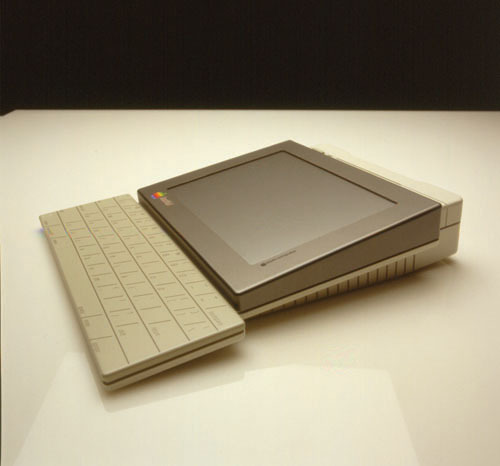
PopSci - Henry Edward Roberts's Altair 8800 started the era of home computing, and inspired a young tinkerer named Bill Gates to write software

"Ed was willing to take a chance on us -- two young guys interested in computers long before they were commonplace -- and we have always been grateful to him," Gates and Allen said in their joint statement on Thursday.
Roberts died on April 1 of pneumonia at the age of 68.
The Altair 8800 represented a $395 DIY kit for early computer geeks in 1975, or about $1557.56 in 2009 dollars. The switch-operated machine contained no display and used the Intel 8080 microprocessor.
Bill Gates and Paul Allen might stand astride the world, but they both paid homage last night to the passing of the man who booted up their careers. The Microsoft founders got their start in the computer biz writing software for the Altair 8800, a forerunner of home computing first created by Henry Edward Roberts, BBC reports.
"Ed was willing to take a chance on us -- two young guys interested in computers long before they were commonplace -- and we have always been grateful to him," Gates and Allen said in their joint statement on Thursday.

Saturday, April 3, 2010
Schneier as the new head of TSA?
A recent opening and hint, gave our nation the hope to have some 'real' improvements in national security.
James Fallows Noted in a interview post with Bruce Schneier "Mr. Sanity about Security" Schneier that there was a high-level job opening at the TSA and he would testify for Schneier as the new head of TSA when he is nominated.
I second that!
James Fallows Noted in a interview post with Bruce Schneier "Mr. Sanity about Security" Schneier that there was a high-level job opening at the TSA and he would testify for Schneier as the new head of TSA when he is nominated.
I second that!
Sunday, March 28, 2010
nerd/dork/geek/dweeb diagram
Have you been unfairly and inaccurately labeled "dorks," only to then exhaustively explain the differences among the three to a more-than-skeptical offender, I say: You're welcome. This nerd/dork/geek/dweeb Venn diagram should save you a lot of time and frustration in the future.

Via Matthew at Sed Contra, who will see you at the intersection of Blogging and Things that Have Latin Names.
Saturday, March 27, 2010

Saturday, March 20, 2010

Friday, March 19, 2010
FAIL - Chat beats logic and information on Web
How does facebook improve the world again?
 Consumerist - It's official WEB FAIL-- playing Farmville and tagging friends in photos has become more popular than actually trying to find things on the internet, as a new report shows Facebook edged out Google as the most-visited site on the internet last week.
According to Hitwise, Facebook accounted for 7.07% of all web traffic for the week ending March 13.
That barely edges out Google's 7.03%.
This is huge news for Facebook, who only a year ago accounted for around 2% of U.S. web traffic and an EPIC fail for the age of the internet...
Read full at Seattle Post-Intelligencer
Young, Dumb, Full Of Risk For ID Theft

WashingtonPost - A new study finds that the young and the feckless are the most at risk for identity theft. 18-24 year olds are more likely to be victimized because they don't check their accounts frequently or thoroughly enough. You can beat the statistics, though, if 1 in 20 times you're tempted to check your friend's Facebook updates you instead scrutinize your account statements. (Thanks to Ben Popken Consumerist!)
Friday, March 12, 2010
The Secret Origin of Windows
SlashDot -

"Windows has been so dominant for so long that it's easy to forget Windows 1.0 was vaporware, mocked both outside and inside of Microsoft — and that its immediate successors were considered stopgaps until OS/2 was everywhere.
Tandy Trower, the product manager who finally got Windows 1.0 out the door a quarter century ago, has written a memoir of the experience. (He thought being assigned the much-maligned project was Microsoft's fiendish way of trying to get rid of him.) The story involves such still-significant figures as Bill Gates, Steve Ballmer, Ray Ozzie, and Nathan Myhrvold; Trower left Microsoft only in November of 2009 after 28 years with the company."
Friday, March 5, 2010

Thursday, March 4, 2010
Google Responds To Privacy Concerns With Unsettlingly Specific Apology

Acknowledging that Google hasn't always been open about how it mines the roughly 800 terabytes of personal data it has gathered since 1998, Schmidt apologized to users— particularly the 1,237,948 who take daily medication to combat anxiety—for causing any unnecessary distress, and he expressed regret—especially to Patricia Fort, a single mother taking care of Jordan, Sam, and Rebecca, ages 3, 7, and 9—for not doing more to ensure that private information remains private.
Monday's apology comes after the controversial launch of Google Buzz, a social networking platform that publicly linked Gmail users to their most e-mailed contacts by default.
"I'd like nothing more than to apologize in person to everyone we've let down, but as you can see, many of our users are rarely home at this hour," said Google cofounder and president Sergey Brin, pointing to several Google Map street-view shots of empty bedroom and living room windows on a projection screen behind him. "And, if last night's searches are any indication, Boston's Robert Hornick is probably out shopping right now for the spaghetti and clam sauce he'll be cooking tonight."
"Either that, or hunting down that blond coworker of his, Samantha, whose Picasa photos he stares at every night," Brin added.
While admitting that security measures need to improve, Google officials also claimed that everyone makes mistakes, be it storing confidential data indefinitely or, say, "having a few too many drinks on the evening of Jan. 23, driving home in a haze, striking a pedestrian on the corner of Mercer and Cavendish, speeding off, and then desperately searching online for hit and run laws, right, Karen?"
"Americans have every right to be angry at us," Google spokesperson Janet Kemper told reporters. "Though perhaps Dale Gilbert should just take a few deep breaths and go sit in his car and relax, like they tell him to do at the anger management classes he attends over at St. Francis Church every Tuesday night."
"Breathe in, breathe out," Kemper added. "We wouldn't want you to have another incident, Dale. Not when you've been doing so well." ;-) Read full at The Onion
Sunday, February 28, 2010

Tuesday, February 23, 2010
Wednesday, February 10, 2010

Monday, February 8, 2010
95% of User-Generated Content Is BS
SlashDot - "The HoneyGrid scans 40 million Web sites and 10 million emails, so it was bound to find something interesting. Among the things it found was that a staggering 95% of User Generated Content is either malicious in nature or spam." Here is the report's front door; to read the actual report you'll have to give up name, rank, and serial number.
Here are the key findings: (via daniweb.com)
* 13.7% of searches for trending news/buzz words (as defined by Yahoo Buzz & Google Trends) led to malware.
* The second half of 2009 revealed a 3.3% decline in the growth of malicious Web sites compared to the first half of the year. Websense Security Labs believes this is due to the increased focus on Web 2.0 properties with higher traffic and multiple pages.
* However, comparing the second half of 2009 with the same period in 2008, Websense Security labs saw an average of 225% growth in malicious Web sites.
* 71% of Web sites with malicious code are legitimate sites that have been compromised.
* 95% of user-generated posts on Web sites are spam or malicious.
* Consistent with previous years, 51% of malware still connects to host Web sites registered in the United States.
* China remains second most popular malware hosting country with 17%, but during the last six months Spain jumped into the third place with 15.7% despite never having been in the top 5 countries before.
* 81% of emails during the second half of the year contained a malicious link.
* Websense Security Labs identified that 85.8% of all emails were spam.
* Statistics for the second half of 2009 show spam emails broke down as 72% (HTML), 11.2% (image), 14.4% (plain text with URL) and 2.4% (plain text with no URL).
* 35% of malicious Web-based attacks included data-stealing code.
* 58% of all data-stealing attacks are conducted over the Web.
Here are the key findings: (via daniweb.com)
* 13.7% of searches for trending news/buzz words (as defined by Yahoo Buzz & Google Trends) led to malware.
* The second half of 2009 revealed a 3.3% decline in the growth of malicious Web sites compared to the first half of the year. Websense Security Labs believes this is due to the increased focus on Web 2.0 properties with higher traffic and multiple pages.
* However, comparing the second half of 2009 with the same period in 2008, Websense Security labs saw an average of 225% growth in malicious Web sites.
* 71% of Web sites with malicious code are legitimate sites that have been compromised.
* 95% of user-generated posts on Web sites are spam or malicious.
* Consistent with previous years, 51% of malware still connects to host Web sites registered in the United States.
* China remains second most popular malware hosting country with 17%, but during the last six months Spain jumped into the third place with 15.7% despite never having been in the top 5 countries before.
* 81% of emails during the second half of the year contained a malicious link.
* Websense Security Labs identified that 85.8% of all emails were spam.
* Statistics for the second half of 2009 show spam emails broke down as 72% (HTML), 11.2% (image), 14.4% (plain text with URL) and 2.4% (plain text with no URL).
* 35% of malicious Web-based attacks included data-stealing code.
* 58% of all data-stealing attacks are conducted over the Web.
Thursday, February 4, 2010
Wednesday, February 3, 2010
Moving Through Time... I think therefore I can
I believe we are at a level of technology and mind mapping to utilize digital interfaces that can enhance this potential... but we are a little busy playing games on our iPhone ;-)
Source: Psychological Science
Setting humans apart from other species is the ability to travel subjectively through time (Suddendorf & Corballis, 2007), a process termed chronesthesia (Tulving, 2002). Mental time travel enables people to tailor their behavior to satisfy the challenges of daily life (Schacter, Addis, & Buckner, 2007; Tulving, 2002). To date, work on chronesthesia has elucidated the neural basis of retrospection and prospection (Addis, Wong, & Schacter, 2007; Schacter et al., 2007) and documented how the process of mental time travel is affected by both aging (Addis, Wong, & Schacter, 2008) and mental illness (D'Argembeau, Raffard, & Van der Linden, 2008).
These insights aside, however, remarkably little is known about the wider psychological characteristics of this pivotal social-cognitive activity. One intriguing question is, how is temporal information processed when one revisits the past or anticipates the future (see Schacter et al., 2007)?
One possibility is that mental time travel may be represented in the sensorimotor systems that regulate human movement. Specifically, the metaphorical "arrow of time" (Casasanto & Boroditsky, 2008) may be grounded in a processing architecture that integrates temporal and spatial information in a directional manner (i.e., past = back, future = forward).
Given that abstract mental constructs can be revealed motorically, or embodied (see Barsalou, 2008), this viewpoint gives rise to an interesting hypothesis: If chronesthesia entails a coupling of thought and action, episodes of retrospection and prospection may be accompanied by backward and forward motion, respectively. To explore this possibility, we measured spontaneous fluctuations in the magnitude and direction of postural sway while individuals engaged in mental time travel.
Dumbing down the world - digital nation on Frontline
Frontline: 'just want to push the pause button of our age and says, what's going on here?'
Quote: It's not that their dumb or not trying... they are trying in a way that is not as effective as it could be. - Because they are distracted by everything else.
The most brilliant minds wasted in an online waste land.
We have created a unlimited way to waste time, dilute the meaning of everything meaningful and distract ourselves from gaining any tangible knowledge or true happiness.
Your digital life is a virtual life, now you have to find out if you want an actual 'life'
The only way to 'live' may be to disconnect...
Monday, February 1, 2010
Using the Power of Emotion for Web Design
Proudly pilfered from Smashingmagazine effectively developing an experience. Storytelling offers a way for the team to really understand what they are building and the audience that they are creating it for. Stories allow for the most complex of ideas to be effectively conveyed to a variety of people. This designed product/experience can then offer meaning and emotion for its users. The professionals that are currently using the power of narrative in their projects are doing it in vastly different ways.
Emotional Design. Through his research, Norman found that design affects how people experience products, which happens at three different levels, and translates into three types of design:
- Visceral Design This design is from a subconscious and biologically pre-wired programmed level of thinking. We might automatically dislike certain things (spiders, rotten smells, etc.) and automatically like others ("attractive" people, symmetrical objects, etc). This is our initial reaction to the appearance.
- Behavioral Design This is how the product/application functions, the look and feel, the usability, our total experience with using the product/application.
- Reflective Design This is how it makes us feel after the initial impact and interacting with the product/application, where we associate products with our broader life experience and associate meaning and value to them.

There is a lot more to emotion than can be covered here, but understanding those basic levels of processing gives us some insight into why storytelling is so powerful. Consider how the levels of thinking play off each other in an amusement park: People pay to be scared. At the Visceral Level we have a fear of heights and danger. At the Reflective Level we trust that it is safe to go on the ride, and we seek that emotionally charged rush and sense of accomplishment (overcoming that fear of heights) after the ride is finished. Knowing that emotion is so vital to how we think makes it more important to create not just a functional and usable experience, but to seek and make a meaningful connection.
Bring Teams Together
User experience professionals typically have to work with people from many different backgrounds. Depending on the type of experience, it might require the effort of everyone from an engineer to a user interface designer. Also, in many cases, the approach in creating websites or applications is to consider the technology, or limitations of that technology, first. Finally, to make matters more complex, larger teams tend be split with concerns regarding their domain. For example, the marketing person is going to focus on their directives and motivations based on their initiatives. This is not always in the end-user's best interest and results in a diluted and poor experience.

The Disciplines of User Experience by Dan Saffer
The infographic above depicts the many different fields that make up the disciplines of user experience. The user experience team selected to create an iPhone application for the masses would be quite different from one that is developing a medical device used by doctors. As described earlier, the individuals that have been involved in crafting stories have been successful in tapping into a way of communicating that has been around for thousands of years. Utilizing storytelling, user experience teams can also inject emotion and value into the end product for users.
Cindy Chastain refers to it as an Experience Theme. She says this theme is "the core value of the experience" being created. Christian Saylor refers to it as finding the Lead Character. Without this user-centered goal, he states, we are just "designing for the sake of designing."

By centering around a specific theme, or character, the uncoordinated elements of an experience all have a clear goal and purpose. With storytelling, a diverse team creating a website or application can collectively link together the tangible elements and create something that is a meaningful experience and is more than just bits and bytes.
Your ability to adhere to a process is dependent on many things, like timeline, budget, and business goals.
In reality, it's not always possible to do everything as specifically outlined. Storytelling is a way to connect teams quickly, and gain insight and understanding. The experiences we create communicate with those elements through the design, content, and user interaction. Storytellers have successfully been communicating for much longer than websites have been around — which makes it a valuable tool from the business side of design.
Please read more at Smashingmagazine
Sunday, January 31, 2010
Saturday, January 30, 2010


Friday, January 29, 2010

Wednesday, January 27, 2010
State of the internet 2009 - Just Numbers
What happened with the Internet in 2009? How many websites were added? How many emails were sent? How many Internet users were there? This post will answer all of those questions and many more.
Email
* 90 trillion - The number of emails sent on the Internet in 2009.
* 247 billion - Average number of email messages per day.
* 1.4 billion - The number of email users worldwide.
* 100 million - New email users since the year before.
* 81% - The percentage of emails that were spam.
* 92% - Peak spam levels late in the year.
* 24% - Increase in spam since last year.
* 200 billion - The number of spam emails per day (assuming 81% are spam).
Websites
* 234 million - The number of websites as of December 2009.
* 47 million - Added websites in 2009.
* 90 trillion - The number of emails sent on the Internet in 2009.
* 247 billion - Average number of email messages per day.
* 1.4 billion - The number of email users worldwide.
* 100 million - New email users since the year before.
* 81% - The percentage of emails that were spam.
* 92% - Peak spam levels late in the year.
* 24% - Increase in spam since last year.
* 200 billion - The number of spam emails per day (assuming 81% are spam).
Websites
* 234 million - The number of websites as of December 2009.
* 47 million - Added websites in 2009.
Sunday, January 24, 2010

Tuesday, January 12, 2010
krebson drops the guantlet... vulnerabilities will rock server community
'After working with the vendors long enough, we've come to conclusion that, to put it simply, it is a waste of time. Now, we do not contact with vendors and do not support so-called "responsible disclosure" policy,' Legerov said."
a slew of previously undocumented vulnerabilities in several widely-used commercial software products, including Mysql, Tivoli, IBM DB2, Sun Directory, and a host of others will be posted. Read more of this story at Slashdot.
a slew of previously undocumented vulnerabilities in several widely-used commercial software products, including Mysql, Tivoli, IBM DB2, Sun Directory, and a host of others will be posted. Read more of this story at Slashdot.
Monday, January 11, 2010
Infobesity... the result of excessive infocalorie consumption.
Bloated with mediocrity as they track their passive lives...

The average twittering brain has 126 followers which implies that an average of 126 brains are being followed back. If all these users stick to an average of 22 TPD (Tweets Per Day), reading the tweets will consume approximately 2.5 hours per day (not to mention responding to them).
Monday, January 4, 2010

Friday, January 1, 2010
Web2.0 suicide machine start 2010 right
Tired of your Social Network?
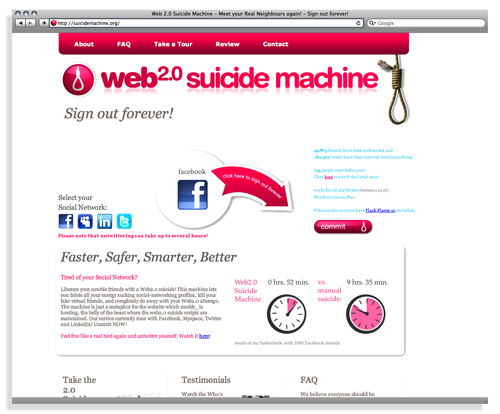
Liberate your newbie friends with a Web2.0 suicide! This machine lets you delete all your energy sucking social-networking profiles, kill your fake virtual friends, and completely do away with your Web2.0 alterego. The machine is just a metaphor for the website which moddr_ is hosting; the belly of the beast where the web2.0 suicide scripts are maintained. Our service currently runs with Facebook, Myspace, Twitter and LinkedIn! Commit NOW!
Feel free like a real bird again and untwitter yourself. Watch it here!
Saturday, December 12, 2009

Friday, December 11, 2009
Google CEO says privacy doesn't matte...
FROM Boing2 Google CEO Eric Schmidt says privacy isn't important, and if you want to keep something private, "maybe you shouldn't be doing it in the first place" (in other words, "innocent people have nothing to hide.")
Bruce Schneier calls bullshit with eloquence: "For if we are observed in all matters, we are constantly under threat of correction, judgment, criticism, even plagiarism of our own uniqueness. We become children, fettered under watchful eyes, constantly fearful that -- either now or in the uncertain future -- patterns we leave behind will be brought back to implicate us, by whatever authority has now become focused upon our once-private and innocent acts. We lose our individuality, because everything we do is observable and recordable."
But JWZ has the kicker, when he reminds us that Eric Schmidt's Google blackballed CNet's reporters after CNet published personal information about Schmidt's private life: ""Google representatives have instituted a policy of not talking with CNET News reporters until July 2006 in response to privacy issues raised by a previous story..." "To underscore its point about how much personal information is available, the CNET report published some personal information about Google's CEO Eric Schmidt -- his salary; his neighborhood, some of his hobbies and political donations -- all obtained through Google searches...."
Hey, Eric: if you don't want us to know how much money you make, where you live, and what you do with your spare time, maybe you shouldn't have a house, earn a salary, or have any hobbies, right?
Monday, November 23, 2009





Monday, November 2, 2009
Schneier points out the difference between “greed sales” and “fear sales”,
PaperJam
As well as being Chief Security Technology Officer at BT, Bruce Schneier is also the author of several books on the topics of security and cryptography with a particular, if not exclusive, focus on the IT industry, which has led The Economist to describe him as a "security guru". And when discussing security he is refreshingly candid and forthright, not dissimilar in tone to Freakonomics author Steven Levitt, while sharing with Levitt the ability to view his chosen field from an angle less ordinary.
Please read full at PaperJam
As well as being Chief Security Technology Officer at BT, Bruce Schneier is also the author of several books on the topics of security and cryptography with a particular, if not exclusive, focus on the IT industry, which has led The Economist to describe him as a "security guru". And when discussing security he is refreshingly candid and forthright, not dissimilar in tone to Freakonomics author Steven Levitt, while sharing with Levitt the ability to view his chosen field from an angle less ordinary.
"Security is hard to sell for two reasons, economic and psychological," he says. The industry is not necessarily logical: it is by nature complex, and as a consequence easy to get wrong. The average buyer doesn't necessarily understand the products on offer, while the industry player often cannot explain them adequately, meaning that "new companies with good ideas often end up floundering because they cannot communicate those ideas." Psychologically, security is also complicated: Schneier points out the difference between "greed sales" and "fear sales", where the former is a simple question of wanting something, while the latter is being afraid of the consequences of not having that thing.
He highlights the concepts of loss aversion and prospect theory and applies them to security, whereby people are much more amenable to avoiding losses than acquiring gains, and are risk-averse for gains, but risk-seeking for losses. As an example, when asked if they would prefer a guaranteed gain of 500 euros or to toss a coin for a gain of 1,000, the vast majority will choose the former. A similar choice, slightly adjusted, shows an interesting contrast regarding risk: faced with a straight loss of 500 euros or a coin toss for the loss of 1,000, people will nearly always choose the latter. This is where the problem for "selling" IT security lies. It is sold through fear of loss, and yet some companies attempt to turn it into a greed sale. As Schneier states, this is somewhat nonsensical: security keeps things as they are if it works properly. It brings no actual value in itself, and thus advertising campaigns portraying a return on investment by a security product are a complete fiction.
Schneier believes that "IT security takes advantage of a rare after-market for making things better." Usually, a consumer will buy a product because it is already "good", yet the IT industry seems fundamentally flawed in that the applications we buy are ostensibly not good. If they were, we wouldn't need the additional security, it would be a standard feature like, as Schneier says "brakes or airbags on a car. You don't buy a car without brakes and then get told you need to fit them afterwards." So why is security in IT like this, when it is not in other industries? Schneier does not blame the IT industry, stating that "this is an effect of how new the IT industry is: it has developed very quickly, and security was ignored in the beginning."
"Computing is becoming infrastructure. It is something taken for granted in the work place, like a desk or electricity," says Schneier. So how can the problem of security sales be addressed? Schneier believes it should not be sold as a separate entity, but included in an overall computing package. He once again brings up the example of cars, which are sold with airbags and brakes included, or houses which are sold with lockable doors. These features are expected on those products, and it should be the same with IT products. Furthermore, it seems the IT industry as a whole is coming around to this way of thinking: "now we are seeing non-security companies buying or taking over security companies. These companies are recognising that security needs to be part of what they do. Users do not necessarily have to understand what the security features do, but at the same time they like to know they are there. Thus, security should become embedded into a greed sell."
Please read full at PaperJam
Monday, October 19, 2009

Thursday, August 27, 2009
Over 40% of Twitter is pointless babble...
A study released by Pear Analytics, a research firm that specializes in website analysis, shows that 41% of all traffic on Twitter is pointless babble, as in “I just combed my hair.” But the more interesting statistic is by how little it actually won out. A very close second, at 38%, were conversational tweets, followed distantly by tweets that had information with real pass-along value (8.7%).
Among the surprises in the study were the low numbers for tweets labeled as corporate self-promotion (5.8%), spam (3.8%) and general news (3.6%). The results were eye opening for the researchers (pdf), who "thought the news category would have more weight than dead last, since this seems to be contrary to Twitter’s new position of being the premier source of news and events.” - Source ohmygov
Monday, August 24, 2009
How To Go To MIT For Free
The businessinsider has written before about the foolishness of pursuing a graduate degree during an economic recession. This popular move--waiting out a recession in school--is actually dumb (see above). Under no circumstances should anyone spend an economic downturn piling on more debt for a degree.
But why are you after that? Is it because you think it's valuable to employers? That might be the case on a temporary basis. But this over-valuation of a degree will eventually be arbitraged away. The smartest employers will quickly figure out how valuable it is to hire an applicant who can demonstrate he took all the MIT Sloan Business School courses online, by himself, and mastered them. And ten years from now, no one will know or care whether you got the degree.
 But there's one exception to the No Graduate School Rule. And that is the Sloan School of Management, the business school of MIT. Actually, it's pretty much all of MIT.
The reason why Sloan is an exception is because you can take nearly every course offered at Sloan without paying a dime, without quitting your job, without finding a new place to live in ultra-expensive Cambridge.
And that's because MIT now gives away its curriculum to anyone smart enough to learn it. It has posted its curriculum on-line for free. These days, this means a staggering 1900 courses. This number will grow.
You are probably skeptical about this. The so-called "Open-Course Ware" doesn't grant any degrees, and MIT says it doesn't count as an "MIT Education." You won't be able to hang a diploma on your wall. But here's what you will be able to do: learn almost everything an MIT student is being taught.
But why are you after that? Is it because you think it's valuable to employers? That might be the case on a temporary basis. But this over-valuation of a degree will eventually be arbitraged away. The smartest employers will quickly figure out how valuable it is to hire an applicant who can demonstrate he took all the MIT Sloan Business School courses online, by himself, and mastered them. And ten years from now, no one will know or care whether you got the degree.
Are you a follower or a leader? How you go to business school--paying through the nose or going for free--tells you all you need to know.
Read more at Business Insider
Average Gamer Is 35, Fat and Bummed
SLASHDOT -  "According to a study published in the upcoming October issue of the American Journal of Preventive Medicine, the average US video game player is 35 years old, overweight, and tends toward depression. Specifically, female video game players tended towards depression, while males tended towards large BMIs. While the study itself points to several conclusions, one researcher noted: '... habitual use of video games as a coping response may provide a genesis for obsessive-compulsive video-game playing, if not video-game addiction.'" On the flip side, the Washington Post is running a story about the mental health benefits of playing video games.
"According to a study published in the upcoming October issue of the American Journal of Preventive Medicine, the average US video game player is 35 years old, overweight, and tends toward depression. Specifically, female video game players tended towards depression, while males tended towards large BMIs. While the study itself points to several conclusions, one researcher noted: '... habitual use of video games as a coping response may provide a genesis for obsessive-compulsive video-game playing, if not video-game addiction.'" On the flip side, the Washington Post is running a story about the mental health benefits of playing video games.
Saturday, August 22, 2009
Thursday, August 20, 2009
Worst at the skills we need the most... 75% not ready for college
WSJ:  "We're not making the progress we need to be making," said Bob White, president of the Alliance for Excellent Education, an advocacy group focused on boosting high-school graduation rates. "The only way you improve these numbers and get them higher is by improving your secondary schools."
About 1.48 million of the 3.3 million members of the high school class of 2009 took the ACT, typically in their junior year. ACT said its report was based on comparing students' ACT test scores in English, reading, math and science with the grades they earned in related courses during their first year in college.
Of course, improving high schools (something that everyone's in favor of) is more easily said than done. The aversion to any kind of accountability in schools doesn't hep the matter. But until these numbers come up, it's premature to keep talking about expanding college opportunities, as politicians tend to do. Merely pushing them into secondary education just represents a waste of time and human capital.
Sunday, August 9, 2009
IT Glory days over
"The NY Times reports that computer science students with the entrepreneurial spirit may want to look for a different major, because if Thomas M. Siebel, founder of Siebel Systems, is right, IT is a mature industry that will grow no faster than the larger economy, its glory days having ended in 2000. Addressing Stanford students in February as a guest of the engineering school, Siebel called attention to 20 sweet years from 1980 to 2000, when worldwide IT spending grew at a compounded annual growth rate of 17 percent. '
All you had to do was show up and not goof it up,' Siebel says. 'All ships were rising.' Since 2000, however, that rate has averaged only 3 percent. His explanation for the sharp decline is that 'the promise of the post-industrial society has been realized.'
In Siebel's view, far larger opportunities are to be found in businesses that address needs in food, water, health care and energy. Though Silicon Valley was 'where the action was' when he finished graduate school, he says, 'if I were graduating today, I would get on a boat and I would get off in Shanghai.'"
From SlashDot
All you had to do was show up and not goof it up,' Siebel says. 'All ships were rising.' Since 2000, however, that rate has averaged only 3 percent. His explanation for the sharp decline is that 'the promise of the post-industrial society has been realized.'
In Siebel's view, far larger opportunities are to be found in businesses that address needs in food, water, health care and energy. Though Silicon Valley was 'where the action was' when he finished graduate school, he says, 'if I were graduating today, I would get on a boat and I would get off in Shanghai.'"
From SlashDot
Friday, August 7, 2009

Monday, August 3, 2009
How big is the internet?
News, Australia - internet has permeated everything from buying to banking to bonking.
But just how big is it?

Microsoft's Bing team puts the amount of web pages at "over one trillion".
And Google has already indexed more than one trillion discrete web addresses.
There are more addresses than there are people on Earth. The current global population stands at more than 6.7 billion.
That means there are about 150 web addresses per person in the world.
Translated: If you spent just one minute reading every website in existence, you'd be kept busy for 31,000 years. Without any sleep. . .
Mark Higginson, director of analytics for Nielsen Online, said the global online population had jumped 16 per cent since last year.
"Approximately 1.46 billion people worldwide now use the internet. . . The largest internet population belongs to China, which claimed this week to have more users online – 338 million - than there were people in the US.
However InternetWorldStats.com a website that combines multiple data sources, claims China's online population is more like 298 million, just a few million shy of overtaking the US population. . .
Measuring the online population can be tricky. There are servers, users, per capita numbers, and penetration percentages to evaluate. It's an epic-scale guessing game using a series of sources to get just one number.
IWS combines data from the UN's International Telecommunications Union, Nielsen Online, GfK and US Census Bureau.
Its latest global figures puts the number of internet users in the world at 1,596,270,108.
Read full from news.com.au
But just how big is it?
Microsoft's Bing team puts the amount of web pages at "over one trillion".
And Google has already indexed more than one trillion discrete web addresses.
There are more addresses than there are people on Earth. The current global population stands at more than 6.7 billion.
That means there are about 150 web addresses per person in the world.
Translated: If you spent just one minute reading every website in existence, you'd be kept busy for 31,000 years. Without any sleep. . .
Mark Higginson, director of analytics for Nielsen Online, said the global online population had jumped 16 per cent since last year.
"Approximately 1.46 billion people worldwide now use the internet. . . The largest internet population belongs to China, which claimed this week to have more users online – 338 million - than there were people in the US.
However InternetWorldStats.com a website that combines multiple data sources, claims China's online population is more like 298 million, just a few million shy of overtaking the US population. . .
Measuring the online population can be tricky. There are servers, users, per capita numbers, and penetration percentages to evaluate. It's an epic-scale guessing game using a series of sources to get just one number.
IWS combines data from the UN's International Telecommunications Union, Nielsen Online, GfK and US Census Bureau.
Its latest global figures puts the number of internet users in the world at 1,596,270,108.
Read full from news.com.au
Sunday, July 12, 2009
Chrome to be virus-free "It's an idiotic claim,"
Making an Operating System Virus Free
Google's claim that Chrome was designed to be virus-free, I said:
Bruce Schneier, the chief security technology officer at BT, scoffed at Google's promise. "It's an idiotic claim," Schneier wrote in an e-mail. "It was mathematically proved decades ago that it is impossible -- not an engineering impossibility, not technologically impossible, but the 2+2=3 kind of impossible -- to create an operating system that is immune to viruses."
What I was referring to, although I couldn't think of his name at the time, was Fred Cohen's 1986 Ph.D. thesis where he proved that it was impossible to create a virus-checking program that was perfect. That is, it is always possible to write a virus that any virus-checking program will not detect.
This reaction to my comment is accurate:
That seems to us like he's picking on the semantics of Google's statement just a bit. Google says that users "won't have to deal with viruses," and Schneier is noting that it's simply not possible to create an OS that can't be taken down by malware. While that may be the case, it's likely that Chrome OS is going to be arguably more secure than the other consumer operating systems currently in use today. In fact, we didn't take Google's statement to mean that Chrome OS couldn't get a virus EVER; we just figured they meant it was a lot harder to get one on their new OS - didn't you?
Thursday, July 2, 2009


Subscribe to:
Posts (Atom)