Tuesday, August 3, 2010

Console owners are “most depressed and socially awkward”

HTML clipboardHTML clipboard

The Harm Of Gaming: We Present The Facts
The perennial questions of the harm that games may be causing us and our children are extremely troubling. Every week seems to bring a new survey or study that demonstrates links between gaming and problematic behavior, with renowned psychologists, sociologists and publicists explaining to us what it is we need to be scared of. Over the last fifteen years I have been studying this data and reading these papers, and I am now ready to publish my findings. Below is the result of a decade-and-a-half's research, and I think will once and for all answer the questions every parent, teacher, child and teenager should be asking.


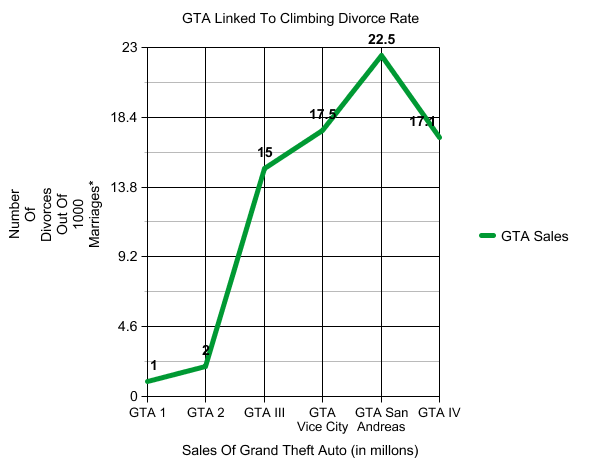
Grand Theft Auto Causes Marriages To Break DownChinatown wars actually caused more marriages, strangely.

While no one is left in any doubt that playing Grand Theft Auto causes anyone under the age of 17 to become dangerously exposed to murder, the longer-term effects on adults have been less examined. As part of my research I thought to compare the sales of each GTA game with what the orce rate must have been when each came out. As you can see each new GTA game has been directly correlated with an increase in orces. While the graph may give the impression that GTA IV has caused fewer orces than Vice City or San Andreas, this game only came out in 2008, so most of the orces it has induced will still be going through the courts and awaiting completion. Expect to see this number soar in the next twelve months.


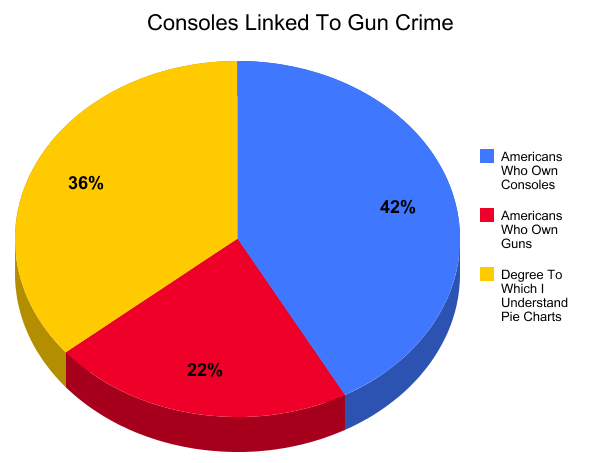
Owning Consoles More Serious Than Gun Crime

A lot of videogames include the use of guns. While these may not be real guns, but rather recreations made of pixels and polygons, it is obvious to anyone playing one of these "simulations" that it is in no meaningful way different from firing a real gun in a school. But it's far scarier than you might have first thought. Nearly twice as many Americans own gun-displaying consoles than those who own the types of guns that require a license and paperwork to purchase. No such paperwork is necessary when buying an Xbox, and yet still teenagers will kill each other in the streets.

Not including guns that are thrown at people.


Please read full from RockPaperShootGun
 

Saturday, July 31, 2010

temporal analytics engine

"goes beyond search" by "looking at the 'invisible links' between documents that talk about the same, or related, entities and events."

The idea is to figure out for each incident who was involved, where it happened and when it might go down. Recorded Future then plots that chatter, showing online "momentum" for any given event.

The "How People Use It" page on Recorded Future's website makes absolutely no attempt to hide The Creepy:
Research a person
Monitor news on public figures to...
Identify future travel plans; spot past travel trends and patterns
Search for communication with other individuals; graph their network
Monitor career history and announced job changes
Find quotations and sound bites in the news and blogs
Discover future and past strategic positioning
Uncover public political ties and family relationships
Exclusive: Google, CIA Invest in 'Future' of Web Monitoring (Wired Danger Room blog)

Wednesday, July 28, 2010

Google Alarm Firefox add-on

Get notified when Google is monitoring your web browsing

animated-siren.gif

Google Alarm shows notifications, plays sound effects and keeps running stats about the % of websites you've visit with Google bugs present. Stay alert – install Google Alarm today.

Sunday, July 25, 2010

Google Bends Over for China

Washington Post-Google promised to "obey Chinese law" and avoid linking to material deemed a threat to national security or social stability, said Zhang Feng, director of the Ministry of Industry and Information Technology's Telecoms Development Department, at a news conference.

China renewed Google's Internet license after it pledged to obey censorship laws and stop automatically switching mainland users to its unfiltered Hong Kong site, an official said Tuesday.

It was Beijing's first public comment on its decision to allow Google to continue operating a China website following a public clash over censorship. The company closed its China search engine in March but still offers music and other services in China.


Thursday, July 22, 2010

Looking for a few good IT

"US security officials say the country's cyberdefenses are not up to the challenge. In part, it's due to a severe shortage of computer security specialists and engineers with the skills and knowledge necessary to do battle against would-be adversaries. The protection of US computer systems essentially requires an army of cyberwarriors, but the recruitment of that force is suffering. 'We don't have sufficiently bright people moving into this field to support those national security objectives as we move forward in time,' says James Gosler

Read more of this story at Slashdot.

Thursday, July 8, 2010

Germans taking on Facebook and google privacy

SlashDot "Not only are Germany and Facebook not friends, they might end up opponents in a courtroom. Germany has begun legal action over privacy. A German data protection official accuses Facebook of illegally saving personal data of people who don't use the site and haven't given permission to access their private information. Germany, which has also launched an investigation into Google over its Street View mapping program, has some of the strictest privacy laws in the world."

Things 2dolist - Crack the "Cyber Command" logo

From da Boing2

The U.S. Military's new "Cyber Command" logo contains a hidden code. Noah Shachtman at Wired News says, "Help us crack it!"

Related reading today: Bruce Schneier says "The Threat of Cyberwar Has Been Grossly Exaggerated."

As usual I have to agree with Bruce...

Wednesday, July 7, 2010

AI - paradoxical mix of intelligence and stupidity

Boing2: While strong AI still lies safely beyond the Maes-Garreau horizon (a vanishing point, perpetually fifty years ahead) a host of important new developments in weak AI are poised to be commercialized in the next few years. But because these developments are a paradoxical mix of intelligence and stupidity, they defy simple forecasts, they resist hype.  Siteimages Hal2 13550They are not unambiguously better, cheaper, or faster. They are something new. What are the implications of a car that adjusts its speed to avoid collisions … but occasionally mistakes the guardrail along a sharp curve as an oncoming obstacle and slams on the brakes? What will it mean when our computers know everything — every single fact, the entirety of human knowledge — but can only reason at the level of a cockroach?

I mention these specific examples — smart cars and massive knowledge-bases — because they came up repeatedly in my recent conversations with AI researchers. These experts expressed little doubt that both technologies will reach the market far sooner, and penetrate it more pervasively, than most people realize.

But confidence to the point of arrogance is practically a degree requirement for computer scientists. Which, actually, is another reason why these particular developments caught my interest: for all their confidence about the technologies per se, every researcher I spoke to admitted they had no clue - but were intensely curious - how these developments will affect society. - "new developments in AI"

Prince Says Internet Is Over

SlashDot - "According to the artist currently known as Prince, 'The internet's completely over.' At least that what he says in an interview with the British newspaper Mirror. Quoting Prince: 'The internet's like MTV. At one time MTV was hip and suddenly it became outdated. Anyway, all these computers and digital gadgets are no good. They just fill your head with numbers and that can't be good for you."

Sunday, June 27, 2010

Code of America Government 1.0 -- in binary

Boing2

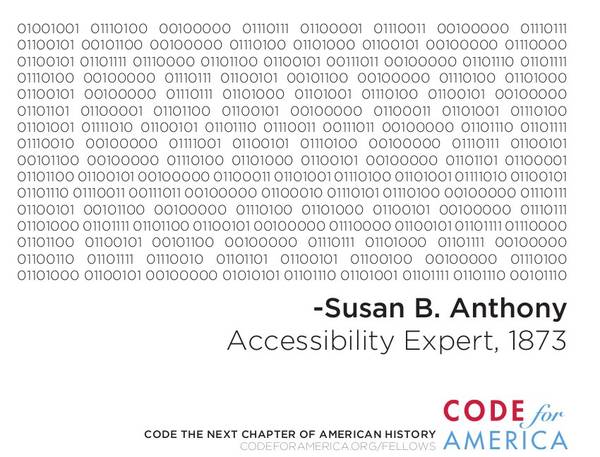
The Code for America project is celebrating July 4 in style, with a set of posters quoting the founders of the USA Government 1.0 in handy binary form. Print and display with pride! Some Fourth of July Decorations

Wednesday, June 23, 2010

Permanently Delete Your Account on Popular Websites

Your computer is a tool, do not become the tool of your computer.
Smashing - Take back your life... delete them all.
  • You can find more information on deleting your Twitter account here.
  • Official instructions for deleting your myspace account can be found here.
  • As far as social networking sites go, LinkedIn probably has the most straight-forward account closure process found here.
  • Full details on deleting your Google account can be found on the Google's Help page "Deleting: Your Google Account".
  • Closing your Windows Live account is actually surprisingly easy.
You just got 30 hours a week of your life back... your welcome ;-)

Tuesday, June 22, 2010

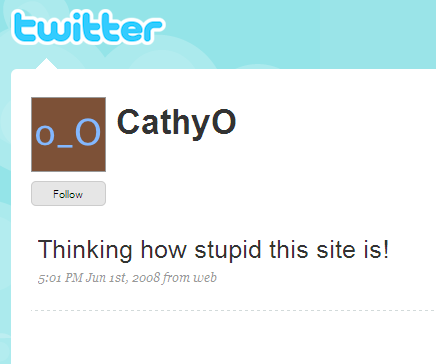
Why Engineers Don't Like Twitter

Because most engineers are smart ;-)
/."A recent EE Times survey of engineers found that 85% don't use Twitter.
More than half indicated that the statement 'I don't really care what you had for breakfast' best sums up their feelings about it.
cathyo-cathyo-on-twitter-stupid-site.png
... authors analyzed the content of tweets during a recent World Cup game, finding 76% of them to be useless.
 "Out of 1,000 tweets with the #worldcup hashtag during the game, only 16 percent were legitimate news and 7.6 percent were deemed 'legitimate conversation' — which leaves 6 percent spam, 24 percent self-promotion, about 17 percent re-tweets,
and a whopping 29 percent of useless observation (like this ;-).
Read more at /.

Sunday, June 20, 2010

Home Computers Equal Lower Test Scores

/. "Politicians and education activists have long sought to eliminate the 'digital divide' by guaranteeing universal access to home computers, and in some cases to high-speed Internet service. But a Duke University study finds these efforts would actually widen the achievement gap in math and reading scores. Students in grades five through eight, particularly those from disadvantaged families, tend to post lower scores once these technologies arrive in their homes."

Wednesday, June 16, 2010

Internet 'kill switch' proposed for US

CNET A new US Senate Bill would grant the President far-reaching emergency powers to seize control of, or even shut down, portions of the internet.
The legislation says that companies such as broadband providers, search engines or software firms that the US Government selects "shall immediately comply with any emergency measure or action developed" by the Department of Homeland Security. Anyone failing to comply would be fined.

That emergency authority would allow the Federal Government to "preserve those networks and assets and our country and protect our people," Joe Lieberman, the primary sponsor of the measure and the chairman of the Homeland Security committee, told reporters on Thursday. Lieberman is an independent senator from Connecticut who meets with the Democrats.

Due to there being few limits on the US President's emergency power, which can be renewed indefinitely, the densely worded 197-page Bill (PDF) is likely to encounter stiff opposition.

TechAmerica, probably the largest US technology lobby group, said it was concerned about "unintended consequences that would result from the legislation's regulatory approach" and "the potential for absolute power". And the Center for Democracy and Technology publicly worried that the Lieberman Bill's emergency powers "include authority to shut down or limit internet traffic on private systems."

The idea of an internet "kill switch" that the President could flip is not new. A draft Senate proposal that ZDNet Australia's sister site CNET obtained in August allowed the White House to "declare a cybersecurity emergency", and another from Sens. Jay Rockefeller (D-W.V.) and Olympia Snowe (R-Maine) would have explicitly given the government the power to "order the disconnection" of certain networks or websites.

A new cybersecurity bureaucracy

Lieberman's proposal would form a powerful and extensive new Homeland Security bureaucracy around the NCCC, including "no less" than two deputy directors, and liaison officers to the Defense Department, Justice Department, Commerce Department, and the Director of National Intelligence. (How much the NCCC director's duties would overlap with those of the existing assistant secretary for infrastructure protection is not clear.)
The NCCC also would be granted the power to monitor the "security status" of private sector websites, broadband providers and other internet components. Lieberman's legislation requires the NCCC to provide "situational awareness of the security status" of the portions of the internet that are inside the United States — and also those portions in other countries that, if disrupted, could cause significant harm.

Read full at CNET

Wednesday, June 9, 2010

Hooked on Gadgets, and Paying a Mental Price

NY Times Thinks the gadgets are dumbing em down... you are correct.
...the effects of the deluge of data. Even after he unplugs, he craves the stimulation he gets from his electronic gadgets. He forgets things like dinner plans, and he has trouble focusing on his family. His wife, Brenda, complains, "It seems like he can no longer be fully in the moment." 

This is your brain on computers. 

Researchers say there is an evolutionary rationale for the pressure this barrage puts on the brain. The lower-brain functions alert humans to danger, like a nearby lion, overriding goals like building a hut. In the modern world, the chime of incoming e-mail can override the goal of writing a business plan or playing catch with the children.
"Throughout evolutionary history, a big surprise would get everyone's brain thinking," said Clifford Nass, a communications professor at Stanford. "But we've got a large and growing group of people who think the slightest hint that something interesting might be going on is like catnip. They can't ignore it."

...researchers were unsure whether the muddied multitaskers were simply prone to distraction and would have had trouble focusing in any era. But she added that the idea that information overload causes distraction was supported by more and more research.

...multitaskers took longer than non-multitaskers to switch among tasks, like differentiating vowels from consonants and then odd from even numbers. The multitaskers were shown to be less efficient at juggling problems.

Other tests at Stanford, an important center for research in this fast-growing field, showed multitaskers tended to search for new information rather than accept a reward for putting older, more valuable information to work.

The results also illustrate an age-old conflict in the brain, one that technology may be intensifying. A portion of the brain acts as a control tower, helping a person focus and set priorities. More primitive parts of the brain, like those that process sight and sound, demand that it pay attention to new information, bombarding the control tower when they are stimulated.

Read on at NY Times

NOTE 2 SuperTechs:
research shows some people can more easily juggle multiple information streams. These "supertaskers" represent less than 3 percent of the population, according to scientists.

Monday, June 7, 2010

Anonymous proxy server who is running it? And why?

FYI newbies-  Many technologies that amateur anonymity fetishists are attracted to are actually designed to harvest information.
HTML clipboard 20090530newbie.jpg
If you wanted a concentrated haul of the most interesting information what would you do?
You would establish a honeypot: a service (free or paid) that purported to provide an anonymous web browsing/email capability. Who knows what people might get up to if they thought nobody was looking? That, of course, is the idea with honeypots.

Cryptogon - Nerds with too much time on their hands get up to all kinds nonsense.
Do they set up anonymous proxy servers and open base stations just to see what people do with them? Yes.
Do criminals do it to find out personal information about you? Yes.

So even if the proxy or base station you're on isn't run by the NSA, who is running it? And why?

High-Traffic Colluding Tor Routers in Washington, D.C., and the Ugly Truth About Online Anonymity It's an old essay, but it has held up remarkably well.

Wired WikiLeaks, the controversial whistleblowing site that exposes secrets of governments and corporations, bootstrapped itself with a cache of documents obtained through an internet eavesdropping operation by one of its activists, according to a new profile of the organization's founder.

The activist siphoned more than a million documents ... supposedly stolen by Chinese hackers or spies who were using the Tor network to transmit the data, were the basis for WikiLeaks founder Julian Assange's assertion in 2006 that his organization had already "received over one million documents from 13 countries" before his site was launched, according to the article in The New Yorker.

Only a small portion of those intercepted documents were ever posted on WikiLeaks, but the new report is the first indication that some of the data and documents on WikiLeaks did not come from sources who intended for the documents to be seen or posted. It also explains an enduring mystery of WikiLeaks' launch: how the organization was able to amass a collection of secret documents before its website was open for business.

Tor is a sophisticated privacy tool endorsed by the Electronic Frontier Foundation and other civil liberties groups as a method for whistleblowers and human rights workers to communicate with journalists, among other uses. In its search for government and corporate secrets traveling through the Tor network, it's conceivable that WikiLeaks may have also vacuumed up sensitive information from human rights workers who did not want their data seen by outsiders.

The interception may have legal implications, depending on what country the activist was based in.
In the United States, the surreptitious interception of electronic communication is generally a violation of federal law..." Read more from
Wired

Wednesday, June 2, 2010

Canada Spending $1B on Security for G8/G20 Summit in June

The Canadian government disclosed Tuesday that the total price tag to police the elite Group of Eight meeting in Muskoka, as well as the bigger-tent Group of 20 summit starting a day later in downtown Toronto, has already climbed to more than $833-million. It said it’s preparing to spend up to $930-million for the three days of meetings that start June 25.
That price tag is more than 20 times the total reported cost for the April, 2009, G20 summit in Britain, with the government estimating a cost of $30-million, and seems much higher than security costs at previous summits ­ the Gleneagles G8 summit in Scotland, 2005, was reported to have spent $110-million on security, while the estimate for the 2008 G8 gathering in Japan was $381-million.

These numbers are crazy. There simply isn't any justification for this kind of spending.

Google phasing out Windows

Tuesday, June 1, 2010

Digital Disconnect Causing Dramatic Drop In Empathy

"Several news sources report that today's college students show a precipitous drop in empathy (here's MSNBC's take). The study shows that students since the year 2000 had 40% less empathy than those 20 and 30 years before them. The article lays out a laundry list of culprits, from child-rearing practices and the self-help movement, to video games and social media, to a free-market economy and income inequality. There's also a link so you can test your very own level of narcissism. Let's hope the Slashdot crowd doesn't break the empathy counter on the downside."


Is "generation me" all about me?
"Many people see the current group of college students — sometimes called 'Generation Me ' — as one of the most self-centered, narcissistic, competitive, confident and individualistic in recent history," said Konrath, 
Konrath's colleague graduate student Edward O'Brien added, "It's not surprising that this growing emphasis on the self is accompanied by a corresponding devaluation of others.”
The role of media Even so, Konrath and O'Brien suggest several reasons for the lower empathy they found, including the ever-increasing exposure to media in the current generation.
"Compared to 30 years ago, the average American now is exposed to three times as much nonwork-related information," Konrath said. "
The rise in social media could also play a role.
"The ease of having 'friends' online might make people more likely to just tune out when they don't feel like responding to others' problems, a behavior that could carry over offline," O'Brien said.
"I clearly am addicted and the dependency is sickening," said one person in the study.  "I feel like most people these days are in a similar situation, for between having a Blackberry, a laptop, a television, and an iPod, people have become unable to shed their media skin."
In the new study... students wrote more than 110,000 words: in aggregate, about the same number of words as a 400-page novel.
"We were surprised by how many students admitted that they were 'incredibly addicted' to media," "But we noticed that what they wrote at length about was how they hated losing their personal connections. Going without media meant, in their world, going without their friends and family." 
Building upon that observation, an alternative explanation is that the students may have identified the "media" as what they were craving, but were actually missing the social connections afforded by the media. In other words, the students were "addicted" to the social ties — friendships and relationships — with others.
"The students did complain about how boring it was go anywhere and do anything without being plugged into music on their MP3 players," said Moeller.
"And many commented that it was almost impossible to avoid the TVs on in the background at all times in their friends' rooms. But what they spoke about in the strongest terms was how their lack of access to text messaging, phone calling, instant messaging, e-mail and Facebook, meant that they couldn't connect with friends who lived close by, much less those far away."
"Texting and IM-ing my friends gives me a constant feeling of comfort," wrote one student. 
"When I did not have those two luxuries, I felt quite alone and secluded from my life.
Although I go to a school with thousands of students, the fact that I was not able to communicate with anyone via technology was almost unbearable." 
Very few students in the study reported that they regularly watched news on television or read a local or national newspaper... They also didn't mention checking mainstream media news sites or listening to radio news while commuting in their cars. Yet student after student demonstrated knowledge of specific news stories.
How did they get the information? 
In a disaggregated way, and not typically from the news outlet that broke or committed resources to a story... "Students expressed tremendous anxiety about being cut-off from information,”
"But most of all they care about being cut off from that instantaneous flow of information that comes from all sides and does not seem tied to any single device or application or news outlet."
That's the real takeaway of this study for journalists: students showed no significant loyalty to a news program, news personality or even news platform. Students have only a casual relationship to the originators of news, and in fact rarely distinguished between news and more general information. 
...often by following the story via "unconventional" outlets, such as through text messages, their e-mail accounts, Facebook and Twitter.
Sunday, May 23, 2010

Recognizing Sarcasm with Computer Algorithms

PopSci - The pursuit of machine intelligence means we have to come up with ways to communicate with our computers in a way both entities can understand. But while computers process verbal commands in a straightforward fashion, humans tend to use more sophisticated speech forms, employing slang or symbols to convey an idea. So an Israeli research team has developed a machine algorithm that can recognize sarcasm.


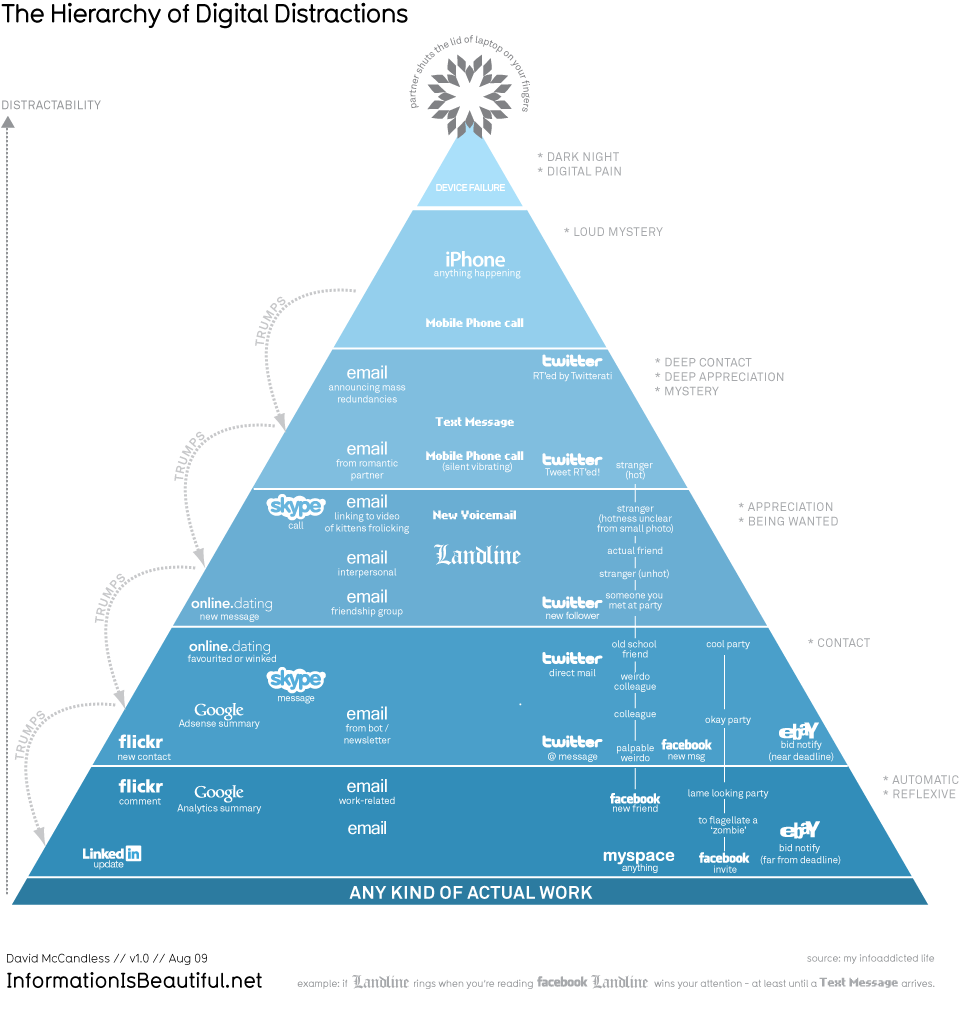
Work or Email... digital diversion.

Geek Alphabet


See more at the "geek Alphabet"

Demise of net knowledge

THEN it was the ultimate tool of knowledge
TIME:  The Internet evolved from a computer system built 25 years ago by the Defense Department to enable academic and military researchers ... built up by people who lived and breathed the hacker ethic -- students at Berkeley and M.I.T., researchers at AT&T Bell Laboratories, computer designers at companies such as Apple and Sun Microsystems. "If there is a soul of the Internet, it is in that community," The scientists who were given free Internet access quickly discovered that the network was good for more than official business. They used it to send each other private messages (E-mail) and to post news and information on public electronic bulletin boards (known as Usenet newsgroups).


Now it is a tool for people to ...withdraw within their walled communities and never venture again into the Internet's public spaces. It's a process similar to the one that created the suburbs and replaced the great cities with shopping malls and urban sprawl. The magic of the Net is that it thrusts people together in a strange new world, one in which they get to rub virtual shoulders with characters they might otherwise never meet. The challenge for the citizens of cyberspace -- as the battles to control the Internet are joined and waged -- will be to carve out safe, pleasant places to work, play and raise their kids without losing touch with the freewheeling, untamable soul that attracted them to the Net in the first place.

Saturday, May 8, 2010

The USA Pavilion Is a Disgrace

POPSci Many of the pavilions at the 2010 Expo in Shanghai are phenomenal, both inside and out. The USA pavilion, however, is neither. But far worse than being visually unimpressive (which it is), the essence of our representation at the largest World's Fair carries an even sadder message.

The mind-blowing pavilions make the failings of the USA's--the world's largest economy--even more shameful.

Soon we may not even have that. This whole scheme looks like it had ZERO creativity at all...

The uninspiring saga of the United States' World Expo pavilion in Shanghai.

Despite nearly two decades of U.S. government inattention to Expos, some in the State Department and the U.S. Expo community had hopes that the United States might put on a better show in Shanghai. In November 2006, the State Department, which had taken over the role of managing U.S. participation at Expos from the USIA, published an official "request for proposal" (RFP) to design, build, and fund a U.S. pavilion in Shanghai. Among other provisions, it required a detailed plan for raising a hefty $75 million to $100 million even though most of the national pavilions at Expo 2010 cost less than $30 million and the eventual U.S. pavilion is budgeted at $61 million. Despite this high bar, several groups of designers, architects, and producers submitted detailed proposals, including a proposal that had Frank Gehry as an architect.

But the State Department rejected them all, and according to correspondence shared between the department and the last rejected proposal group, the RFP ended in late 2007 without a team in place.

Saturday, May 1, 2010

“We Have Met the Enemy and He Is PowerPoint”

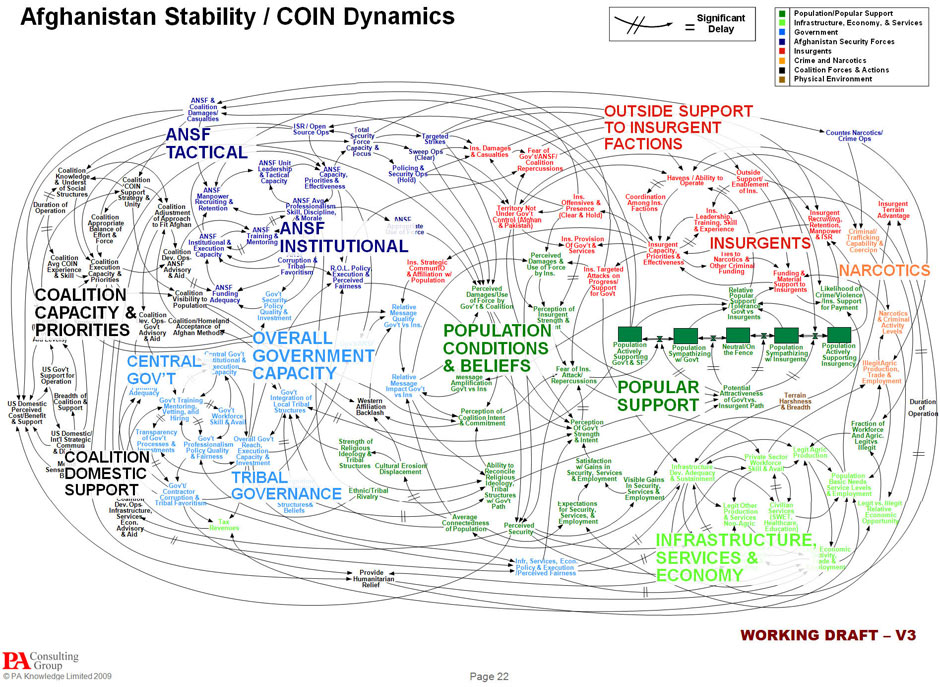
New York Times Via: crypto Gen. Stanley A. McChrystal, the leader of American and NATO forces in Afghanistan, was shown a PowerPoint slide in Kabul last summer that was meant to portray the complexity of American military strategy, but looked more like a bowl of spaghetti.http://punditkitchen.files.wordpress.com/2009/10/political-pictures-death-powerpoint.jpg
"When we understand that slide, we'll have won the war," General McChrystal dryly remarked, one of his advisers recalled, as the room erupted in laughter.
The slide has since bounced around the Internet as an example of a military tool that has spun out of control. Like an insurgency, PowerPoint has crept into the daily lives of military commanders and reached the level of near obsession. The amount of time expended on PowerPoint, the Microsoft presentation program of computer-generated charts, graphs and bullet points, has made it a running joke in the Pentagon and in Iraq and Afghanistan.

"PowerPoint makes us stupid," Gen. James N. Mattis of the Marine Corps, the Joint Forces commander, said this month at a military conference in North Carolina. (He spoke without PowerPoint.) Brig. Gen. H. R. McMaster, who banned PowerPoint presentations when he led the successful effort to secure the northern Iraqi city of Tal Afar in 2005, followed up at the same conference by likening PowerPoint to an internal threat.

"It's dangerous because it can create the illusion of understanding and the illusion of control," General McMaster said in a telephone interview afterward. "Some problems in the world are not bullet-izable."

In General McMaster's view, PowerPoint's worst offense is not a chart like the spaghetti graphic, which was first uncovered by NBC's Richard Engel, but rigid lists of bullet points (in, say, a presentation on a conflict's causes) that take no account of interconnected political, economic and ethnic forces. "If you divorce war from all of that, it becomes a targeting exercise," General McMaster said.

Commanders say that behind all the PowerPoint jokes are serious concerns that the program stifles discussion, critical thinking and thoughtful decision-making.

Sunday, April 4, 2010

Honoring the Father of the PC

PopSci - Henry Edward Roberts's Altair 8800 started the era of home computing, and inspired a young tinkerer named Bill Gates to write software

Roberts died on April 1 of pneumonia at the age of 68.

The Altair 8800 represented a $395 DIY kit for early computer geeks in 1975, or about $1557.56 in 2009 dollars. The switch-operated machine contained no display and used the Intel 8080 microprocessor.

Bill Gates and Paul Allen might stand astride the world, but they both paid homage last night to the passing of the man who booted up their careers. The Microsoft founders got their start in the computer biz writing software for the Altair 8800, a forerunner of home computing first created by Henry Edward Roberts, BBC reports.

"Ed was willing to take a chance on us -- two young guys interested in computers long before they were commonplace -- and we have always been grateful to him," Gates and Allen said in their joint statement on Thursday.

Saturday, April 3, 2010

Schneier as the new head of TSA?

A recent opening and hint, gave our nation the hope to have some 'real' improvements in national security.
James Fallows Noted in a interview post with Bruce Schneier "Mr. Sanity about Security" Schneier that there was a high-level job opening at the TSA and he would testify for Schneier as the new head of TSA when he is nominated.
I second that!


Sunday, March 28, 2010

nerd/dork/geek/dweeb diagram

From GreatWhiteSnark

Have you  been unfairly and inaccurately labeled "dorks," only to then exhaustively explain the differences among the three to a more-than-skeptical offender, I say: You're welcome. This nerd/dork/geek/dweeb Venn diagram should save you a lot of time and frustration in the future.

Nerd Dork Geek Venn Diagram

Via Matthew at Sed Contra, who will see you at the intersection of Blogging and Things that Have Latin Names.

Friday, March 19, 2010

FAIL - Chat beats logic and information on Web

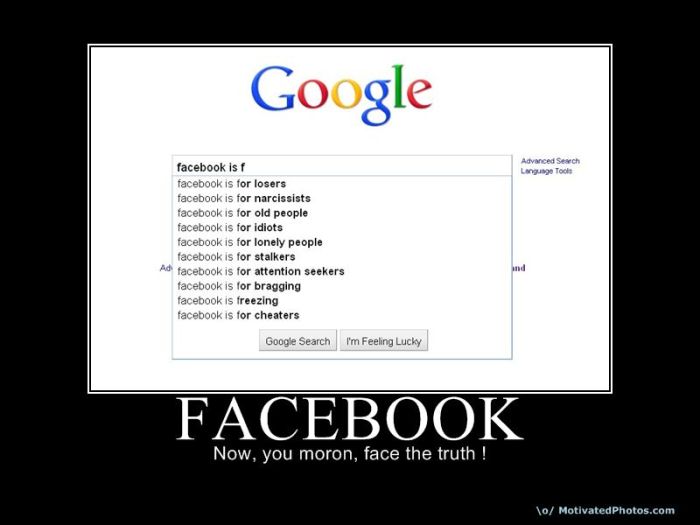
How does facebook improve the world again?
Consumerist - It's official WEB FAIL-- playing Farmville and tagging friends in photos has become more popular than actually trying to find things on the internet, as a new report shows Facebook edged out Google as the most-visited site on the internet last week.

According to Hitwise, Facebook accounted for 7.07% of all web traffic for the week ending March 13.

That barely edges out Google's 7.03%.

This is huge news for Facebook, who only a year ago accounted for around 2% of U.S. web traffic and an EPIC fail for the age of the internet...

Read full at Seattle Post-Intelligencer

Young, Dumb, Full Of Risk For ID Theft

WashingtonPost - A new study finds that the young and the feckless are the most at risk for identity theft. 18-24 year olds are more likely to be victimized because they don't check their accounts frequently or thoroughly enough. You can beat the statistics, though, if 1 in 20 times you're tempted to check your friend's Facebook updates you instead scrutinize your account statements.  (Thanks to Ben Popken Consumerist!)

Thursday, March 4, 2010

Google Responds To Privacy Concerns With Unsettlingly Specific Apology

Acknowledging that Google hasn't always been open about how it mines the roughly 800 terabytes of personal data it has gathered since 1998, Schmidt apologized to users— particularly the 1,237,948 who take daily medication to combat anxiety—for causing any unnecessary distress, and he expressed regret—especially to Patricia Fort, a single mother taking care of Jordan, Sam, and Rebecca, ages 3, 7, and 9—for not doing more to ensure that private information remains private.